Top 23 Etsy Business Ideas (That Actually Make Money)

Did you know that Etsy has an extremely local customer base looking for exceptional customer service and personalized goods?

Etsy is known as a platform for small business owners. You might find the Etsy marketplace ideal if you have handmade stuff to sell. We came up with 23 of the best Etsy shop ideas to attract Etsy shoppers.

We’ll introduce you to Etsy and discuss the profitability of Etsy stores. Then we’ll discuss profitable Etsy shop ideas and answer some frequently asked questions.

You won’t believe how much some of these unique etsy shop ideas make! You can either keep reading straight through or click on any of the links below to jump to the section that interests you:

What is Etsy?

Etsy is an online marketplace where 7 million shop owners sell handmade, vintage, and personalized products to Etsy’s 92 million buyers. The primary Etsy listing categories are:

  • Art & Collectibles
  • Craft Supplies
  • Clothing & Shoes
  • Home & Living
  • Jewelry & Accessories
  • Seasonal Offerings
  • Toys & Entertainment
  • Wedding & Party

Is it still profitable to sell on Etsy?

The owner of TagPup posing with a dog collar, a sewing machine, and an open laptop with the Etsy logo.

Yes, it can be highly profitable to sell on Etsy. According to Etsy’s 2023 annual report, the amount due to sellers increased by 13.4%, which indicates that sellers are making more money than in previous years. The key is to differentiate yourself from the competition by having unique Etsy shop ideas.

Vlad Kuksenko discusses what it takes to be an Etsy seller in his UpFlip Academy course, The Etsy Blueprint. He explains that Etsy is focused on keeping eCommerce human. That means the items for sale are often personalized or handmade.

Great Etsy Shop Ideas

Idea #1. Personalized Gifts

According to Etsy people search for birthday gifts every second, anniversary gifts every two seconds, and baby gifts every three seconds.

Some of the best Etsy shop ideas include personalized gift ideas. Etsy shoppers love personalized items because they seem more thoughtful to the recipient. Consider creating personalized mugs or other customized items to help people celebrate special occasions.

• Average annual revenue: $458K
• Average profit margin: 8.4%
• Average startup cost: $30K
• Average time to launch: 4 months
• Projected market growth: 2.6%
• Market size: $25.2B

The average gift store makes more than $458K per year with an 8.4% profit margin.

Check out our interview with Vlad to learn how he became one of Etsy’s top sellers. Vlad’s Etsy shop focuses on selling personalized dog collars and makes over $600K each year.

YouTube player

Idea #2. Wall Art

According to Etsy, wall art makes the perfect Etsy shop idea. There’s a sale every two seconds.

• Average annual revenue: $1.3M
• Average profit margin: 3.80%
• Average startup cost: $150K
• Average time to launch: 12 months
• Projected market growth: 3.4%
• Market size: $69.5B

This Etsy shop idea would be considered part of the home decor sector. The average home decor shop makes $1.3M per year with a 3.8% profit margin.

Idea #3. Handmade and Custom Furniture

Creating unique furniture is another of the best Etsy shop ideas.

• Average annual revenue: $2.3M
• Average profit margin: 3.7%
• Average startup cost: $275K
• Average time to launch: 15 months
• Projected market growth: 2.2%
• Market size: $147B

Furniture stores average $2.3M in sales with a 3.7% profit margin. Find out how Blacktail Studio makes $15K monthly with woodworking in our interview below:

YouTube player

Idea #4. Vintage Clothing

Many Etsy shop ideas involve vintage items. Clothing is considered vintage when it’s at least 20 years old.

• Average annual revenue: $493K
• Average profit margin: 6.7%
• Average startup cost: $55K
• Average time to launch: 9 months
• Projected market growth: 1.5%
• Market size: $14.2B

Selling vintage clothing has an average profit margin of 6.7%, and it’s part of a $14.2 billion industry.

Katie Echeverry started Unique Vintage with just $2K and it’s now one of the fastest-growing privately held companies in the United States. Find out how she started it below:

Idea #5. Pet Store

People love spending money on their pets. The average pet store makes $1.6 million per year with a 4% profit margin. While you’re brainstorming pet businesses, remember that your Etsy shop idea should still focus on something personalized or handmade.

• Average annual revenue: $1.6M
• Average profit margin: 4%
• Average startup cost: $150K
• Average time to launch: 15 months
• Projected market growth: 1.7%
• Market size: $28.8B

Find out more about Vlad’s company, TagPup, in our interview below:

YouTube player

If your Etsy store sells pet food or treats, make sure you’re aware of government regulations and shipping policies. You probably won’t do well if you ship food that spoils by the time it gets to your customers.

Idea #6. Beauty Supply Store

Etsy users are always looking for new ways to beautify their homes as well as themselves.

• Average annual revenue: $427K
• Annual profit margin: Unknown
• Average startup cost: $110K
• Average time to launch: 12 months
• Projected market growth: 3.7%
• Market size: $36.5B

Selling beauty products on Etsy isn’t the easiest idea to get into. Etsy requires your beauty products to comply with government regulations, which may be a challenge for some people.

Idea #7. Handmade Jewelry

A table full of handmade beaded jewelry and hair accessories.

Handmade jewelry is one of the best Etsy shop ideas. Etsy businesses sell everything from hemp necklaces and jewelry-making kits to custom engagement and wedding rings.

• Average annual revenue: $1M
• Average profit margin: 4.3%
• Average startup cost: $60K
• Average time to launch: 9 months
• Projected market growth: 2.8%
• Market size: $72.6B

I will warn you that many of the people who start selling on Etsy aren’t completely honest with their jewelry pricing. When we were shopping for rings, we found Etsy ideas were often mislabeled or downright fraudulent when listing diamond and gold style.

Just being honest can be a huge advantage because the pricing is phenomenal compared to a brick-and-mortar store.

Idea #8. Handmade Soap

Selling handmade soap, body wash, and other hygiene products is a great Etsy shop idea.

• Average annual revenue: $9.6M
• Average profit margin: 5.4%
• Average startup cost: $55K
• Average time to launch: 15 months
• Projected market growth: 2.1%
• Market size: $47.4B

Given that soap companies make an average of $9.6 million per year, you could make some real money if your Etsy store idea takes off.

Idea #9. Handmade Candles

New Etsy sellers might consider making candles and selling them on Etsy.

• Average annual revenue: $1.6M
• Average profit margin: 10.8%
• Average startup cost: $1.1K
• Average time to launch: 2 months
• Projected market growth: 1.7%
• Market size: $2.9B

Jen and Jocelyn started RxLA as a side gig. Today, they’re making $500K per year. Watch our interview with the owners to learn more:

YouTube player

Idea #10. Fabric Shop

Maybe you’re not the most creative small business owner. That doesn’t mean there aren’t Etsy customers for you. Businesses on Etsy need suppliers, and they often look on Etsy too.

Selling craft supplies like fabric can be an extremely profitable online business.

• Average annual revenue: $158K
• Average profit margin: 4%
• Average startup cost: $62.5K
• Average time to launch: 4 months
• Projected market growth: 0.40%
• Market size: $4.6B

Keep reading for more easy things to sell on Etsy.

Idea #11. Party Supplies

A laptop open to the Etsy results page for party favors.

Party favors are a good business idea for easy things to make and sell on Etsy. As we mentioned earlier, there’s an Etsy search involving the word birthday every second.

• Average annual revenue: $779K
• Average profit margin: 8.3%
• Average startup cost: $30K
• Average time to launch: 3 months
• Projected market growth: 1%
• Market size: $7.9B

Help people celebrate their special occasions with your new Etsy shop.

Idea #12. Bridal Boutique

It shouldn’t surprise you that the wedding industry has a major presence on Etsy.

• Average annual revenue: $4.7M
• Average profit margin: 6.6%
• Average startup cost: $150K
• Average time to launch: 9 months
• Projected market growth: 0.30%
• Market size: $26B

When my wife and I planned our wedding, she spent hundreds of hours reviewing Etsy sellers. We got everything from our rings to signage to decorations from Etsy shops.

Idea #13. Pallet Supplier

The owner of Blacktail Studio standing in a warehouse full of pallets.

As far as Etsy shop ideas go, this one may sound a little odd, but selling wooden pallets is a great Etsy shop idea.

• Average annual revenue: Unknown
• Average profit margin: Unknown
• Average startup cost: $55K
• Average time to launch: 9 months
• Projected market growth: Unknown
• Market size: Unknown

You can sell the pallets as they are or do a little work to prepare them so that other Etsy buyers can start creating crafts right away.

Idea #14. Crochet Supplies

Crochet hooks, yarn, buttons, and crochet kits all sell on Etsy fairly well. You might consider this Etsy shop idea if you want to sell craft supplies.

• Average annual revenue: Unknown
• Average profit margin: Unknown
• Average startup cost: Unknown
• Average time to launch: Unknown
• Projected market growth: 5.2%
• Market size: $50.9B

Crochet supplies fall under the umbrella of arts and crafts. Since this is only a small part of such a large market, annual revenue and profit will vary widely.

Idea #15. Baby Clothes

The Etsy search results page for baby clothes.

Parents love getting customized baby clothes for the newest edition to their family. That makes cute baby clothing one of the easiest things to sell on Etsy.

• Average annual revenue: $179K
• Average profit margin: 5%
• Average startup cost: $100K
• Average time to launch: 8 months
• Projected market growth: 0.9%
• Market size: $32B

Baby clothes are part of the larger market for clothing boutiques and apparel.

Idea #16. Digital Goods

While many Etsy niche ideas are centered around handmade crafts or designs with customization features, you can also sell digital goods. This category includes templates, checklists, guides, and watercolor clip art images.

• Average annual revenue: $125K
• Average profit margin: Unknown
• Average startup cost: $6K
• Average time to launch: 2 months
• Projected market growth: 1.9%
• Market size: $16.9B

Just make sure you add some flair in addition to functionality. Etsy customers care about how items look just as much as they care about usefulness. Digital goods are some of the easiest Etsy ideas to sell because they only have to be made once.

Idea #17. Shoe Store

A tablet showing the UpFlip blog about how to open a shoe store.

You might consider a new Etsy business that sells handmade or custom shoes.

• Average annual revenue: $4.8M
• Average profit margin: Unknown
• Average startup cost: $350K
• Average time to launch: 9 months
• Projected market growth: 1.8%
• Market size: $62.2B

Custom shoes would make great personalized gifts. You can even offer fun designs for special occasions.

To learn more about this niche, read our blog about how to open a shoe store.

Idea #18. Baby Accessories

Like other clothing, baby accessories are great things to make and sell on Etsy.

• Average annual revenue: $179K
• Average profit margin: 5%
• Average startup cost: $100K
• Average time to launch: 8 months
• Projected market growth: 0.9%
• Market size: $32B

You can sell handmade items or personalize them by letting customers add the baby’s name, birthday, or cute phrases.

Idea #19. Hat Shop

The owner of TagPup posing with a sewing machine in front of a custom hat shop.

Selling cowboy hats, bandanas, and other head gear can be a profitable Etsy store idea. Find some hats at a good price, buy some materials to bedazzle them, and get started.

• Average annual revenue: $829K
• Average profit margin: 6.7%
• Average startup cost: $150K
• Average time to launch: 4 months
• Projected market growth: 0.6%
• Market size: $1.6B

You might be wondering, “What can I make to sell on Etsy that works on hats?” If so, check out some of these cool hats for inspiration.

Idea #20. Custom T-Shirts

T-shirts are another great idea of things to sell on Etsy. There are tons of print-on-demand companies where you can create your own designs and allow customization. The supplier prints the T-shirts when you receive an order.

• Average annual revenue: $1.1M
• Average profit margin: 3.5%
• Average startup cost: $30K
• Average time to launch: 9 months
• Projected market growth: 2.5%
• Market size: $13B

Just be careful with this business model. As Vlad warned:

Some companies may not be fast enough to comply with Etsy’s shipping policies, which can result in lost revenue even though the product has been shipped.

Idea #21. Greeting Card Store

A woman holding a thank you card in the card aisle at a store.

Cards are used for birthdays, weddings, holidays, thank you notes, and so much more. There are so many occasions that people need cards for that you’re sure to find demand in this niche.

• Average annual revenue: $11M
• Average profit margin: 1.2%
• Average startup cost: $150K
• Average time to launch: 8 months
• Projected market growth: 1.9%
• Market size: $6.8B

If you love holidays and special occasions, create seasonal items to make it even more fun.

Idea #22. Tote Bags

Have you considered tote bags, backpacks, and other bags while thinking about what to make and sell on Etsy?

• Average annual revenue: $407K
• Average profit margin: 11.4%
• Average startup cost: $150K
• Average time to launch: 7 months
• Projected market growth: 2%
• Market size: $28.5B

Start your own business and make handmade items that people use to carry their stuff. Keep reading for more easy Etsy shop ideas.

Idea #23. Fashion Accessories

An Etsy results page showing accessories like keychains.

Creating cute fashion accessories for your own Etsy store is a great way to use your creative juices and make a living.

• Average annual revenue: $179K
• Average profit margin: 5%
• Average startup cost: $100K
• Average time to launch: 8 months
• Projected market growth: 0.9%
• Market size: $32B

Go check out ideas by taking a look at best-selling accessories. Don’t be afraid to experiment!

Learn to Create Your Own Etsy Shop

You can learn how to create a top-selling Etsy shop in the UpFlip Academy. Vlad teaches how to open an Etsy store with two examples of stores in different markets.

You’ll also have the chance to learn about different sectors and business models. To learn more about print on demand, sign up for Ryan Hogue’s course. Ryan’s print-on-demand business now earns him almost $50K per month.

Etsy Shop Ideas FAQ

How do I choose what to sell on Etsy?

A woman shrugging and pointing to the name Etsy and three floating dollar signs.

When choosing an Etsy shop idea, you should consider four factors:

  • Will you enjoy doing it?: Starting an Etsy shop is hard work. If the shop content doesn’t interest you, you might not want to do it. Then again, Vlad started TagPup even though he doesn’t have a dog.
  • Are there other Etsy sellers doing it?: It’s harder to create a popular Etsy shop idea than it is to satisfy an existing need. If nobody is doing it, there’s probably no money in it.
  • How much search volume is there?: The more people search for the products your Etsy business is selling, the more you can make.
  • What ancillary products could your Etsy store sell?: The best Etsy shop ideas give you the chance to expand your inventory. Make sure to choose a versatile Etsy shop idea that’s scalable.

You’d be surprised by some of the Etsy shop ideas that are highly successful. For instance, the Etsy store Carolina Leg Co sells furniture legs. They’ve sold over 17,000 items with prices between $50 and $1,100.

How to cross list products for maximum reach

Popular Etsy shop ideas don’t have to limit themselves to being exclusively an Etsy business. When you start your own Etsy shop, you can also sell on other marketplaces including:

  • Your own website
  • Social media (including Pinterest and Reddit)
  • Amazon
  • eBay
  • Poshmark
  • AliExpress
  • Temu.com
  • Walmart.com
  • Zazzle.com
  • Wayfair.com
  • Target.com
  • Mercari.com

I was surprised to find out that Pinterest, YouTube, and Reddit make up 72.7% of the social media traffic to Etsy. Make sure to include them in your marketing mix.

How to cross list to other marketplaces

When an Etsy store wants to cross-list, there are different ways to do it. Some software will use an application programming interface, while others will use spreadsheets. Here’s the basic process:

  1. Research the new marketplace to understand pricing and policies.
  2. Collect the data for the products you want to cross list.
  3. Make sure you don’t have to change pricing for any of the products.
  4. Add items to the new marketplace.
  5. Verify the information is correct and formatted properly.
  6. Publish to the new store.

Check out this blog on the best cross listing software to consider.

How can I research trending Etsy shop ideas?

The owner of RxLA candles pointing to two stacks of soy candles in a warehouse.

Some of the best ways to find trending Etsy shop ideas include:

What is the easiest thing to sell on Etsy?

Digital downloads are the easiest Etsy shop idea because they don’t require any inventory. Just create the templates, workbooks, graphics, or printables.

After that, all you need to do is market them. Your profit margin will increase with each sale on your Etsy shop.

Are there products I can’t sell in Etsy shops?

A screen showing the Etsy policy page about what shop owners can sell on Etsy.

Etsy has rules and policies about what you can sell on their platform. They prohibit the sale of these items:

  • Alcohol
  • Illegal drugs
  • Illegal items
  • Pharmaceutical drugs
  • Stolen products
  • Tobacco
  • Products that may be subject to complicated legal regulations

Read through Etsy’s policies to learn more.

How should I price products in my Etsy shop?

Calculating the price of products you sell in an Etsy shop includes:

  • Materials and labor: Include your costs for craft supplies, time, shipping, and marketing to establish the price for your Etsy shop.
  • Etsy fees: Add the fees for listing items and processing transactions. These can be up to 25% for Etsy shops according to the Etsy fee page.
  • Competitor pricing: While you’re considering Etsy shop ideas, remember to analyze the market. Unless there’s something remarkably better than the existing products, you want to stay in the middle to high range.
  • Profit margin: Figure out how much you want to earn for each sale. Given the Etsy fees, you may want to target between two and three times your costs.

Did you find the perfect Etsy shop idea?

Now that you’ve considered some Etsy small business ideas, it’s time to decide what you want to do with your online business. You’ll want to choose an Etsy shop name, do some market research, and start making things to sell.

Once you’re ready to make it official, we recommend Bizee to handle the business formation process for you, including preparing and filing the necessary paperwork with your state.

Etsy buyers are looking for all kinds of unique items. If you’re ready to make your Etsy store ideas a reality, check out our blog about how to start selling on Etsy.

Which idea sounds the most appealing to you? Let us know in the comments below.

212 Best Farm Names (for 2026)

Are you buying a farm or starting any kind of farm business? You’ll want to come up with some creative farm names. What are good farm names? Well, the best farm name ideas combine farm references with some indication of what you do.

Consider some of these farm business name categories. Then use the helpful tips while naming your farm. Jump to any category to find a memorable name to attract potential customers to your new farm.

Get ready to find a farm business name you’ll love—and be inspired by some of our favorite super-successful farmers and farm business owners.

26 Funny Farm Names

Farmer holding a chicken in front of a red barn with "funny farm names" written on a blackboard behind him

While the funny farm is slang for a mental hospital, these funny names are for a farm business that raises animals or grows food.

1. Moo La Land Farm
2. Chuckle Hut Homestead
3. Quack Shack Ranch
4. Giggling Gourd Gardens
5. Poultry in Motion Farm
6. Fifty Shades of Hay
7. Feather Friends Farm and Petting Zoo
8. Crop Circle Circus
9. Snicker Snack Fields
10. Loco Harvest Haven
11. Udder Delight Homestead
12. Chuckleberry Acres
13. Grin and Grain Gardens

14. Whimsical Weeds Farmstead
15. Barnyard Banter Ranch
16. Hootenanny Homestead
17. Laughing Llama Meadows
18. Silly Sprout Fields
19. Chuckle Cove Cultivators
20. Giggle Grove Gardens
21. Quirk Quarters Ranch
22. Udder Nonsense Farm
23. Egg-cellent Acres
24. The Laughing Stockyard
25. Legen Dairy Farm
26. One or the Udder Farm

Pro Tip: When selecting a funny farm name, let humor be your guide while keeping it lighthearted and universally appealing. Incorporate puns, wordplay, or playful references related to farming, animals, or crops to add a touch of whimsy.

Consider your target audience and ensure the humor aligns with their sensibilities. Test the name on friends or family to gauge its comedic impact. A funny farm name can create a memorable and enjoyable brand, but be cautious not to choose anything offensive or too niche.

Striking the right balance between wit and charm will make your farm stand out and leave a lasting impression on customers. Great example: Epic Gardening. Is Kevin Espiritu tooting his own horn, or just telling it like it is with his catchy gardening blog name? You can decide after you watch our interview that details exactly how he turned his backyard farming side hustle into a multimillion-dollar-a-year business.

YouTube player

20 Cute Farm Names

Want a cute farm name? Consider some of these:

1. GreenVista Farms
2. Harvest Haven
3. Meadow Bliss
4. Sunlit Acres
5. Rustic Roots Farm
6. Sown Serenity
7. Prairie Purity
8. Golden Fields Ranch
9. Tranquil Tiller Farm
10. Cedar Grove Homestead

11. Valley View Gardens
12. Whispering Winds Ranch
13. Country Charm Cultivators
14. Evergreen Meadows
15. Serene Pasture Farm
16. Blue Sky Harvest
17. Hidden Grove Gardens
18. Rolling Hills Homestead
19. Noble Oak Orchard
20. Gilded Grain Fields

Pro Tip: When choosing a catchy farm name, consider incorporating elements that reflect the essence of your farm, such as its location, key crops or produce, or the values it represents.

Additionally, ensure the name is easy to remember, spell, and pronounce. Check online and local business directories to avoid unintentional duplicates, and choose a name that resonates with your target audience. Next, get your domain name from Dream Host.

A unique and memorable farm name not only sets you apart but also contributes to brand recognition and customer recall, fostering a positive and lasting impression.

46 Good Farm Names

There are plenty of good farm business names. Consider some of these for your farm business:

1. Ironwood Oasis Farm
2. Mystic Meadows Ranch
3. Whispering Wind Homestead
4. Hidden Hills Ranch
5. Timber Trail Homestead
6. Starlight Serenity Farm
7. Radiant Ridge Meadows
8. Solitude Springs Homestead
9. Mountain Breeze Fields
10. Whispering Waters Farmstead
11. Sunset Symphony Ranch
12. Serendipity Sown Fields
13. Sunkissed Summit Homestead
14. Whispering Willow Vineyard
15. Azure Sky Harvest
16. Harmony Hills Ranch
17. Rustic Refuge Fields
18. Blissful Birch Homestead
19. Mystic Maple Homestead
20. Mountain Vista Meadows
21. Cedar Ridge Ranch
22. Whispering Willow Fields
23. Tranquil Terrace Homestead

24. Rolling Ridge Vineyard
25. Whispering Wind Ranch
26. Sunset Symphony Fields
27. Starlight Serenity Homestead
28. Hidden Hills Vineyard
29. Rustic Refuge Meadows
30. Blue Horizon Ranch
31. Timber Trail Fields
32. Green Valley Produce
33. The Orchard
34. Ripe Production
35. Cornucopia Produce
36. Sunny Side Farms
37. Green Acres
38. Harvest Moon
39. Green Thumb Farms
40. Farm to Table
41. Green Meadows
42. Farmhouse Country Crops
43. Harvest Bounty
44. Countryside Fields
45. Berry Lush Hills
46. Fertile Valley Farms

Pro Tip: When selecting a cool farm name, aim for a combination of creativity and relevance.

Consider incorporating words or phrases that evoke a sense of adventure, uniqueness, or modernity while staying connected to your farm’s identity or products. Think about the overall vibe you want to convey and choose a name that aligns with the personality of your farm.

Additionally, check online platforms and databases to ensure the chosen name is not already in use. A cool farm name should not only resonate with your target audience but also spark curiosity and interest, making it a memorable and attractive choice for your agricultural venture.

Miami Fruit’s name strikes a perfect balance. It’s both straightforward (hello, delicious fruit) and place-based (Miami is known for its fun vibes, right?). Learn more about the one-of-a-kind seven-figure business venture in this video:

YouTube player

Try Our Free Farm Name Generator

We’ve made choosing a farm name easier than ever. Just input your business description and our free AI business name generator will provide 12 business name ideas. favorite the ones you like, then click on it to buy the domain name.

30 Cool Farm Names

Think farm life is cool? Consider a farm business name like the ones below.

1. Enchanted Harvest Homestead
2. Labyrinth of Crops Farmstead
3. Celestial Sow Ranch
4. Whimsy Willow Fields
5. Timeless Terra Gardens
6. Nebula Nectar Vineyard
7. Secret Sanctuary Farm
8. Celestial Meadows Ranch
9. Zenith Zen Garden
10. Kaleidoscope Cultivators
11. Ethereal Eden Homestead
12. Aether Acres
13. Utopia Uplands Farm
14. Quasar Quarters Ranch
15. Ponderosa Paradise Fields

16. Solar Symphony Gardens
17. Tranquil Tendril Homestead
18. Velvet Vale Vineyard
19. Synchronicity Sown Farm
20. Blissful Bounty Ranch
21. Terra Nova Meadows
22. Radiant Roots Farmstead
23. Infinite Harvest Haven
24. Serenity Springs Homestead
25. Terra Tint Fields
26. Terra Firma
27. Sunburst Farmstead
28. Wildwood Harvest
29. Blossoming Acres
30. Honeycomb Fields

Pro Tip: When selecting a creative farm name, let your imagination roam freely while keeping it connected to the essence of your farm.

Combine words, concepts, or themes that evoke a sense of innovation and uniqueness. Consider the story you want your farm name to tell and how it aligns with your values or the products you offer.

Embrace metaphors, symbols, or cultural references that resonate with your target audience. Check for name availability online to avoid duplicates and ensure that your chosen name is easy to spell and remember.

A creatively crafted farm name can serve as a powerful storytelling tool, helping your agricultural venture stand out and fostering a strong connection with customers.

You don’t need to settle on a business name right away. Sometimes, new business owners come up with the perfect name while they’re planning out other parts of their business.

Graduation icon

Farm Your Next Great Business Idea with the UpFlip Academy

Start creating your dream business today! It’s easy with the UpFlip Academy. Now with dozens of business programs and workshops, you can start planning a business that is both valuable and profitable. Plus, you’ll get access to a community of entrepreneurs and business mentors like Joshua Brown, whose pressure washing business makes $2M per year, and Brandon Vaughn, who went from food stamps to bringing in $750K per month! They have the secrets and they’re sharing them exclusively with our community.
Don’t wait—start your business today!

24 Unique Farm Names

Wooden baskets full of produce with a chalk board sign that reads "unique names" situated among them

A farm business name should stand out from the pack. Consider some of these names to get your creative juices flowing.

1. Agrarian Endeavors
2. Rural Resources Ranch
3. Precision Harvest Homestead
4. Sustainable Fields Farm
5. EcoHarvest Holdings
6. TerraSphere Cultivators
7. ProHarvest Partners
8. Modern Farmstead Solutions
9. AgriTech Ventures
10. CultivaCore Agriculture
11. TerraLogic Holdings
12. Harvest Hub Farms

13. GreenVista Agro Ranch
14. ProSeed Precision Farms
15. TerraForm Innovations
16. Sustainable Harvest Network
17. PrimeCrop Agribusiness
18. HarvestSphere Homestead
19. AgriVision Holdings
20. TerraCatalyst Farms
21. EcoGrove Ranching
22. Apex Agro Solutions
23. GreenHarbor Harvesters
24. TerraNexa Cultivators

Pro Tip: When choosing a professional farm name, envision it on business signage, marketing materials, and digital platforms. Choose a name that is not only representative of your farm’s values and offerings but is also visually and verbally versatile.

A professional farm name should be easy to pronounce, spell, and remember, facilitating effective communication with customers and partners. Consider the scalability of the name as your business grows and ensure it aligns with a professional and trustworthy image.

Finally, conduct a thorough online search to confirm domain name and social platform availability, securing a cohesive online presence for your professional farm.

34 Chicken Farm Names

Old McDonald had a farm and on his farm, he had a chicken. What did he name his farm?

1. E-I-E-I-O Farms
2. Willow’s Haven Farm
3. Meadow Dreams Homestead
4. Sunflower Ridge Ranch
5. Whispering Oaks Fields
6. Hen-derson’s Happy Chicks
7. Cedar Haven Homestead
8. Cluck Cluck Here
9. Grandma’s Yolk Farm
10. Evergreen Embrace Ranch
11. Here a Cluck
12. Feather Lite Acres
13. There A Cluck
14. Tranquil Tendril Ranch
15. Ponderosa Pines Homestead
16. The Egg-cellent Adventure
17. Golden Gateways Farm

18. Lush Legacy Ranch
19. Starlight Sanctuary Fields
20. The Happy Cluckery
21. Everywhere a Cluck Cluck
22. Whispering Winds Homestead
23. Jolly Wings Farm
24. Ethereal Eden Ranch
25. Rolling Ridges Farmstead
26. Sunset Valley Cluckers
27. Gentle Grove Fields
28. Enchanted Elm Fields
29. Second Chance Sanctuary
30. Elysian Echo Ranch
31. Tranquil Terrace Farm
32. Cluckingham Palace
33. The Yolk’s on Us Farm
34. Rustic Reverie Fields

Pro Tip: If you opt for a personal-sounding farm name, focus on creating a connection between your farm and the individuals who will interact with it.

Consider incorporating elements of personal significance, such as family names, local landmarks, or sentimental references. This not only adds a touch of authenticity but also fosters a sense of familiarity for your customers.

Additionally, choose a name that resonates emotionally and reflects the warm and inviting atmosphere you want to convey. A personal-sounding farm name creates a more intimate brand identity, making customers feel like they are part of a unique and cherished community.

Marion Acres is a poultry farm with a great name and a unique story. Check it out in our exclusive interview:

YouTube player

32 Catchy Farm Names

Catchy farm names might reference the natural environment or the critters you keep with names like:

1. Sunshine Acres
2. Ozark Orchards Homestead
3. Green Gables
4. Rockies Retreat Farmstead
5. Bluegrass Bliss Ranch
6. Pacific Peak Fields
7. Shenandoah Valley Homestead
8. Gulf Coast Gardens
9. Adirondack Acreage Ranch
10. Sierras Solitude Farm
11. Chesapeake Charm Fields
12. Napa Valley Nexus Homestead
13. Everglades Essence Ranch
14. Green Mountain Grove
15. Desert Mirage Farmstead
16. Cape Cod Cultivators

17. Yellowstone Yonder Fields
18. Palmetto Plains Homestead
19. Great Lakes Gardens
20. Pine Ridge Ranch
21. Mojave Meadow Fields
22. Finger Lakes Farmstead
23. Hoppin’ Mad Ranch
24. Sow Much Love Farm
25. Sundown Patch
26. Rooted in Tradition Farm
27. County Fairground Greens
28. Barn Quilt Farm
29. Bluegrass Dairy Farm
30. Happy Hens Sanctuary
31. Squealing Piglet Acres
32. Moovelous Hilltop

Pro Tip: Consider a location-based farm name that identifies the geographic setting and captures the essence and unique features of your area. Consider the landscape, local flora or fauna, historical landmarks, or cultural elements that make your location special.

This ensures that your farm name reflects a sense of pride and connection to the community. Additionally, think about the scalability of the name in case your farm expands or diversifies its offerings.

A well-chosen location-based name not only roots your farm in a specific place but also helps create a strong local identity, attracting customers who appreciate the regional character of your agricultural venture.

What Should I Name My Farm Company?

A good farm name communicates the essence of your farm while being memorable, distinctive, and relevant. Here are some key factors that contribute to a good farm name:

  • Relevant: Choose a name that reflects the nature of your farm, whether it’s related to the crops you grow, the livestock you raise, or the farming practices you employ.
  • Memorable: A good farm name should be easy to remember. Avoid overly complex or confusing names that may be hard for customers to recall.
  • Distinct: Ensure that your farm name stands out from competitors. Avoid generic terms and aim for a unique and original name that sets your farm apart.
  • Value-Driven: If your farm has specific values or principles, consider incorporating them into the name. This helps convey a sense of authenticity and purpose.
  • Positive Imagery: Choose words or phrases that evoke positive emotions and imagery. This creates a favorable impression and attracts customers.
  • Scalable: Think about the future growth and diversification of your farm. A good name should be versatile enough to accommodate potential changes in your offerings or business focus.
  • Cultural and Regional Considerations: If your farm is rooted in a specific culture or region, consider incorporating elements from that culture or region into the name. This adds a local touch and connection.
  • Avoids Trends: While it’s tempting to follow current trends, consider that trends change quickly. Opt for a timeless name that will remain relevant over the long term.
  • Available: Before finalizing a name, check for its availability online and in business registries to ensure there are no conflicts or trademark issues.
  • Easy Pronunciation and Spelling: A good farm name should be easy for customers to pronounce and spell correctly. This facilitates word-of-mouth marketing and online searches.

Remember that your farm name is an essential part of your brand identity and take the time to choose a name that aligns with your vision and values and will resonate with your target audience.

How to Name Your Farm Business

Miami Fruits owner holding a box full of plantains

Registering your farm’s name is a pivotal step in building and safeguarding your agricultural brand. Here’s a step-by-step guide on how to register your farm’s name:

  1. Check Availability: Before you settle on a name, make sure it isn’t already in use by another farm, especially in your agricultural sector and location. Conduct online searches, check local business directories, and examine trademark databases to confirm the availability of your chosen name.
  2. Perform a Trademark Search: A thorough trademark search is essential to ensure your chosen farm name is not already trademarked by another entity. This step is crucial for legal protection and to avoid potential infringement issues.
  3. Buy the Domain: In today’s digital landscape, securing an online presence is crucial. Check the availability of your farm name as a domain to secure a corresponding website address. Even if you don’t plan an immediate website launch, reserving the domain is a wise move for future use.
  4. Determine the Legal Structure: Define the legal structure of your farm, whether it’s a sole proprietorship, partnership, LLC, or corporation. The chosen structure will impact the registration process.
  5. Register with the Local Agricultural Authority: Officially register your farm name with the relevant local agricultural authority. The process varies depending on your location but often involves filing a “Doing Business As” (DBA) or trade name registration with the appropriate local agency.
  6. Consider Trademark Registration: While not mandatory, registering your farm name as a trademark with the relevant intellectual property office can offer additional legal protection. This becomes especially crucial if you plan to expand your farm’s presence nationally or internationally.
  7. Claim Online Platforms and Social Media: Secure your farm name on popular social media platforms and relevant online marketplaces, even if you don’t intend to use them immediately. Maintaining a consistent brand across various channels strengthens your online presence.
  8. Renew and Maintain: Stay vigilant about renewal requirements for your farm’s registration and trademark, if applicable. Regularly update your contact information to ensure you receive renewal notices.

By following these steps, you can effectively register your farm’s name, establish a robust brand identity, and shield your agricultural business from potential legal challenges. If you have specific questions or concerns about the registration process in your area, consult with legal professionals or agricultural advisors.

Next Steps After Choosing Your Farm Name

In conclusion, choosing the perfect name for your farm is an exciting step that sets the tone for your agricultural journey. Whether you’re drawn to catchy or cool, professional or personal, the key is to find a moniker that resonates with your values and captures the essence of your venture.

To spark your creativity, we provided examples of farm names that are funny, cute, cool, and beyond. Consider exploring all the lists then mixing and matching elements to create a name that suits your farm’s personality perfectly.

Once you’ve found the perfect name, the next step is to register it. We recommend using Bizee, which makes the registration process quick and easy. Follow our suggested steps for registering farm names, ensuring legal protection and a solid foundation for your brand. Don’t forget to check for domain availability and secure your online presence for future growth.

Graduation icon

Launch Your Farming Venture with UpFlip Academy

Naming your farm is just the beginning. UpFlip Academy offers comprehensive support to help you start any type of farm or farm-related business. With over 500 business ideas, a vibrant founders community, and insights from successful entrepreneurs, you’ll have everything you need to achieve your farming goals swiftly and efficiently.
Begin your journey today!

Remember, the right name for your farm is a blend of creativity, relevance, and resonance. Trust your instincts, involve others for feedback, and enjoy the process of naming your farm. Happy farming!

210 Unique Hair Business Name Ideas

Have you decided to start cutting hair and offering hair care products? 

Launching a hair company is a great way to make a living, but there’s a lot of competition. It’s important to think about creative hair business names before you start offering hair services. We’ve got you covered!

We’ll share some of the best practices for creating a memorable hair brand and hook you up with our free name generator. We’ll also provide you with lots of names for hair businesses and answer some commonly asked questions about the hair industry.

You can either read straight through or click on any of the links below to jump to the section that interests you:

Get ready to find a hair business name you’ll love!

What makes a good hair business name idea?

A barbershop owner holding clippers and shears underneath a sign that says name?

A good hair business name helps customers understand more about your products and services. Choose a name that’s short and easy to remember. Your business name should also be unique enough to stand out from competitors.

Try Our Free Hair Business Name Generator

Coming up with name ideas can be challenging, but we’ve got you covered. Our free name generator will help you find ideas and show you whether each name is available as popular domains. Try our hair business name generator today!

20 Best Hair Business Name Ideas

A sign that says True Lengths sitting on a table next to barbershop supplies.

You might like some of these hair business name ideas: 

1. Bangin’ Beauty
2. Glorious Curls
3. Wonderful Waves
4. Graceful Waves
5. Handsome Hairlines
6. Lovely Lowlights
7. Magnificent Ombre
8. Majesty of Balayage
9. True Lengths
10. Radiant Highlights

11. Splendid Curls
12. Root Revival
13. Superb Highlights
14. Symmetry Salon
15. Tasteful Tresses
16. Visionary Curls
17. Gorgeous Bangs
18. Ombre Oasis
19. Curl Confidence
20. Silk Touch

Pro Tip: Check to make sure your preferred business name is available as a domain. We recommend purchasing your domain from DreamHost.

25 Unique Hair Business Name Ideas

You might find the perfect hair business name on this list of unique names:

1. Uptown Hair
2. Dye Hard
3. Cutting Edge
4. Color Lounge
5. Hair Affair
6. Mane Attraction
7. Hair Parlour
8. Pretty Parlor
9. Hair Therapy
10. Hairitage
11. Le Salon
12. Tresses
13. Hair Haven

14. Icon Salon
15. Luxe Locks
16. Hair Republic
17. Le Salon
18. Hair She Goes
19. Mane Magic
20. Tress Studio
21. Strand Society
22. Indigo Hair Gallery
23. Fusion Hair
24. Essence Hair Co
25. Straight & Sleek

Pro Tip: Check the U.S. Patent and Trademark Office website to make sure there isn’t an existing trademark on your hair brand name idea.

10 Unique Hair Business Names for Instagram

A speech bubble with the name Genteel Hair next to a cell phone with the Instagram logo.

Instagram is the perfect place to show off your hair business. Consider some of these catchy unique hair business names:

1. Glamorous Roots
2. Fringe & Flair
3. Part Perfection
4. Genteel Hair
5. Twist of Fate

6. Cultured Curls
7. Dignified Hair Design
8. Ladylike Locks
9. Gentleman’s Mane
10. Hair Products Galore

30 Classy Names for Hair Business

If you want a classy business name, you might use words like refined, elegant, stylish, or chic.

1. The Luxe Strand Studio
2. Elegant Edge 
3. Refined Tresses
4. The Velvet Tress
5. Silk Strand 
6. Collective Hair Company
7. Elegant Tresses
8. Tasteful Updos
9. Stylish Strands
10. Sophisticated Salon
11. Refined Hair Design
12. Chic Coiffures
13. Polished Looks
14. Graceful Hair
15. Exquisite Braids

16. Sumptuous Styles
17. Opulent Hair
18. Deluxe Hair Studio
19. Grand Hair Salon
20. Lavish Locks
21. High-End Hair
22. Upscale Braids
23. Premium Hair Care
24. Exclusive Hair Designs
25. Prestigious Salon
26. Ritzy Tresses
27. Swanky Styles
28. Posh Hair
29. Stately Strands
30. Courtly Coifs

Pro Tip: Classy salon names aren’t enough to create a luxury brand. You’ll also need to think about the logo, the atmosphere, and the service you provide to give it a truly remarkable feel. Learn more about luxury brand names.

20 Cute Hair Business Names

The name Hairstyle Glories in a frame surrounded by combs and hair clips.

When your target audience is female a memorable brand can be created by choosing cute hair business name ideas. Consider some of these cute names.

1. Alluring Tresses
2. Final Touch Hair
3. Exquisite Updo
4. Glamorous Strands
5. The Hair Edit
6. The Braid Bar
7. Plaited Charm
8. Ponytail Appeal
9. Hairdo Enchantment
10. Bun & Bloom

11. Perm Allure
12. Hair Haus
13. Locks of Loveliness
14. Hair Flow Co.
15. The Beauty Line
16. Hairstyle Glories
17. Braided Beauty
18. Picture Perfect Pigtails
19. Natural Styles
20. Updo Artistry

Pro Tip: Find more cute names for businesses in our other blogs.

30 Catchy Hair Business Names

Consider some of these catchy hair salon names for your hair business:

1. Weave Got You Covered
2. Fresh Cut Studio
3. Glow & Flow Hair Studio
4. Shears
5. Vibe Hair Boutique
6. Hair on Mane
7. Shear Genius
8. The Hair Whisperer
9. Lock Star
10. The Mane Event
11. The Hair Vault
12. Curl Up & Dye
13. Hair We Go
14. Blowout Bar
15. Braidery

16. Tress to Impress
17. Hair Raisers
18. Color Crew Salon
19. Style Hutch
20. Snip City
21. Strand Stand
22. Hair Lab
23. Hair Haven
24. The Hair Bar
25. Hair Code
26. Gloss Boss
27. The Hair Architect
28. The Mane Objective
29. Shear Bliss
30. The Hair Lounge

30 Creative Hair Business Names

A blonde wig on a mannequin head next to the name Premium Wig Co.

Creative salon names are a fun way to stand out.

1. Snip and Sizzle
2. Curl Craze
3. Pure Essence Hair Salon
4. True Hair
5. Premium Wig Co.
6. The Braid Brigade
7. The Color Chameleon
8. The Hair Haven
9. The Style Station
10. The Hair Alchemist
11. Mane Muse
12. Tressformers
13. The Lock Lab
14. Crimp & Crown
15. Shear Artistry

16. The Strand Stylist
17. The Mane Stage
18. Snip & Sip
19. Braid Whisperer
20. Hue Haven
21. Hair Goals
22. Curl Whisperer
23. Updo Empress
24. Tressed to Kill
25. Hairloom Salon
26. Head Turners
27. Lock & Key Salon
28. Hairitage House
29. Hair Academy
30. In Your Roots

Pro Tip: You can mix creative words for hair or hair stylists to come up with clever hair business names. The name Tressformers uses this strategy.

30 Barbershop Name Ideas

The hair industry isn’t just about women’s hair. Men go to barbershops and other hair stylists too. Consider some of these barbershop name ideas:

1. Sharp Edge
2. Gentleman’s Den
3. Fade Factory
4. Clean Cut Club
5. Beard Baron
6. Scissor Shack
7. Buzz Stop
8. Man Cave Barbershop
9. Dapper Den
10. Classic Cut
11. The Razor’s Edge
12. Shave & Shape
13. Buzz & Blade
14. [Your Name] Groom Room
15. Trim & Proper

16. [Your Name] Scissorhands
17. Barber’s Lounge
18. Fade Masters
19. Beard & Blade Co.
20. Modern Man Barbershop
21. Shave Cave
22. Clipper King
23. The Gentleman’s Refuge
24. Executive Cuts
25. Urban Barber
26. Sharp Shooter Barbershop
27. Beard Boss
28. Fade Zone
29. Clean Cut Crew
30. Sharp & Dapper

Bernard Franklin started Busy B’s Barbershop with just $15K. Learn more about starting a hair business by watching our interview with him below:

YouTube player

15 Unique Hair Salon Names

You might consider some of these salon business name ideas. 

1. Mane Street Salon
2. Mod Salon
3. Secret Salon
4. Elegance Hair Salon
5. Glamour Salon
6. Chameleon Salon
7. Element Hair Salon
8. Snip Society

9. The Tress Code
10. Hair Curator
11. Braid Bar & Lounge
12. The Crown Collective
13. The Curl Sanctuary
14. Color Confidante
15. Hair Apothecary

Pro Tip: Want more good salon names? Check out our blog with 471 salon name ideas.

How to Register the Right Hair Business Name

Once you’ve found a name for your hair business, you’ll want to:

  1. Verify availability of your business name. 
  2. Buy the domain name.
  3. Set up social media handles.
  4. Register your business.
  5. Create your brand identity.
  6. Create a website.
  7. Start marketing your hair business.

FAQ

What is a fancy name for a hair business?

A hairstylist pointing to a list of fancy business name terms that includes parlor, beauty bar, and boutique.

A hair business with a fancy name might use upscale words such as parlor, beauty bar, or boutique. Consider mixing and matching luxury terms with ordinary words like shop or establishment.

How do I market my hair salon business?

Some of the best ways to successfully market your hair salon business include sharing before-and-after photos on social media accounts and maintaining a Google Business Profile. You may also want to start a loyalty program, offer referral discounts, or partner with other beauty businesses to expand your outreach.

Making it easy for customers to book and pay for appointments is also part of a stellar customer experience. Consider adding online booking to your website and allow people to easily pay with different payment options. 

One of my wife’s favorite hair stylists allows people to pay using Venmo and encourages them to do it publicly so that people are always seeing payments for hair. This effectively acts as a way to market her hair company.

When you’re paying for marketing, you’ll want to define your target audience and only run ads during hours you’re open. Make sure to track and optimize your campaigns to maximize results.

Hair salon logo design ideas

The owner of Busy Bs Barbershop standing in front of a screen with salon logo templates.

In addition to a hair company business name, you’ll probably want a logo. Many hair salons use logos that either have a silhouette of a person’s head, scissors, or other hair styling tools. Canva has hundreds of hair salon logo templates.

Where can I check business licenses and permit requirements?

You can check the requirements to start a hair business on the secretary of state’s website for your area. Most states require you to attend cosmetology school before you can start your own hair business. Other permits and licensing may be necessary.

How do you check if the name of a company already exists?

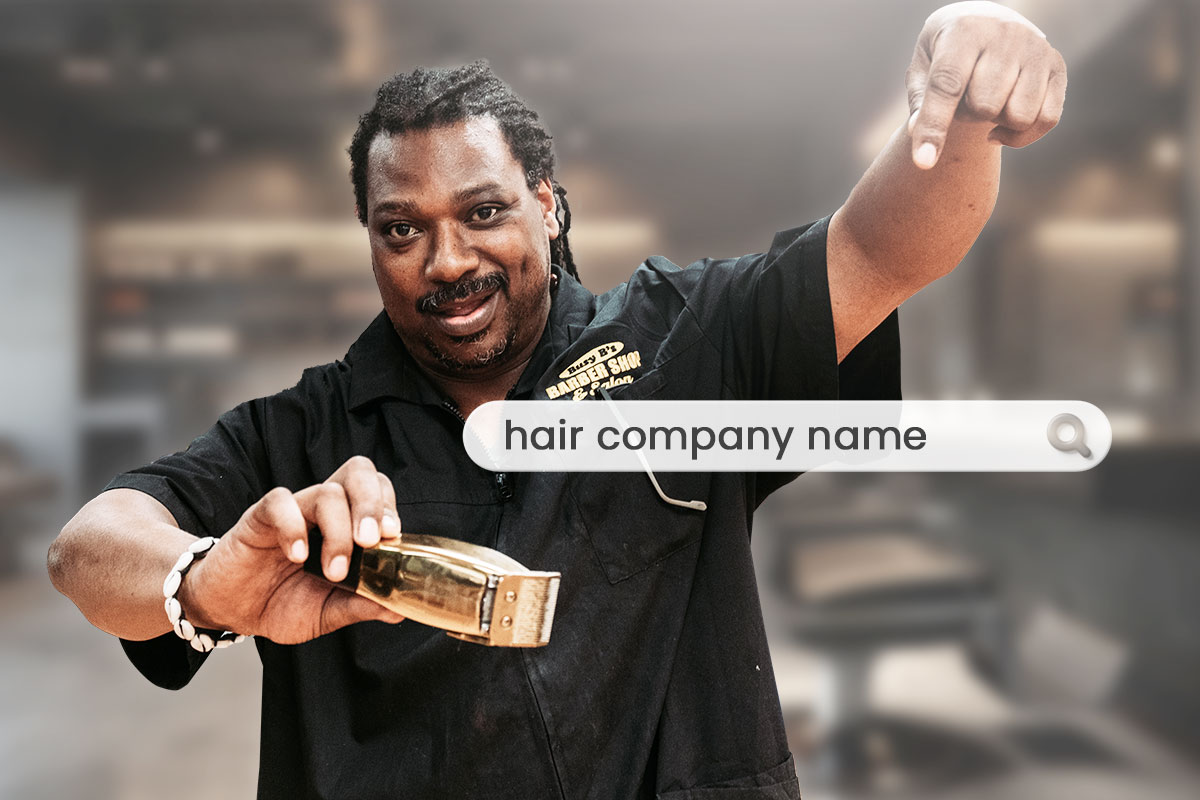
A barbershop owner holding clippers and pointing to a search bar that says hair company name.

To check if a hair company name exists, start by using a search engine. Normally, you’ll get results if there are any businesses using the hair company names you like. If you don’t find a website or social media handles for your favorite hair business names, that’s a good indicator that nobody is currently using them.

You’ll also want to perform a business name search on your secretary of state’s website to see if your preferred name is available in your state. Once you confirm that no one else is using it, you can register as a limited liability company.

You’ll also want to check the U.S. Patent and Trademark Office to verify that your desired hair company names aren’t trademarked by another entity. You can’t use the name when someone has trademarked it because you’d be infringing upon their intellectual property.

What type of hair business names do you like?

There are plenty of ways to come up with a name for your hair business. First, we explained what makes a good name for a hair company. Then we provided a diverse range of inspiring ideas for different types of hair companies.  

We also hooked you up with our hair business name generator and shared best practices to help you stand out in a competitive market. We even share the story of a barber shop owner to help you on your exciting journey.

From here, you’ll want to put together a business plan, build a strong brand identity, and cultivate a loyal customer base. We hope our naming tips and suggestions make it easy to find potential customers.

What type of hair business names make the most memorable impression to you? Let us know in the comments below.

12 Best Podcast Hosting Sites in 2026

Over the last decade, podcast listeners have increased from 12% of the population to 42%. So if you’re thinking of starting a podcast, your audience is out there somewhere. But with millions of podcasts online today, the podcast hosting platform you choose will make a difference when it comes to connecting with the right listeners.

We’ll cover the top podcast hosting platforms, including some you may not have heard about before. We’ll also help you determine the best podcast platforms based on price, features, pros, and cons.

When you’re done reading this blog, you’ll know which of the podcast hosting services you want to use for your own podcast. You can either read from start to finish or click on any of the links below to jump to the section that interests you:

What is a podcast hosting platform?

A podcast playing on a laptop next to a microphone with podcast platform logos floating nearby.

Podcast hosting platforms are where you upload your podcast content. The podcast host safely stores your media files online and provides an RSS feed link, making it easy to add your podcast to directories like Spotify and Apple Podcasts.

Podcast hosting platforms also help you avoid playback issues and the hassle of managing data storage. Some podcasting platforms don’t charge based on the storage size, so you can upload larger files and provide listeners with better sound quality.

What features should a podcast hosting site offer?

There are numerous podcast hosting sites online that offer features you may value. However, certain upgrades just aren’t worth paying extra for. Some of the important factors you should consider include:

  • Simplicity: The best podcast hosting platforms are easy to use.
  • Ample bandwidth: Bandwidth determines the number of times your podcast can be downloaded in a set period. Larger audiences need more bandwidth.
  • Distribution capabilities: There are different podcast directories. The hosting site you choose should make it easy to add your podcast directly from their platform.
  • Monetization features: Some podcast hosts offer features to help you make money. These are important because it simplifies your job.
  • Podcast analytics: Analytics help you understand your listeners and how you’re performing. Note that the more sophisticated the analytics, the more they usually cost.
  • Competitive pricing: Put simply, you don’t want to pay more than you have to because it eats into your profits.
  • Storage: Your hosting service may have storage limitations. You need to be aware of how storage works and how much your show will require.
  • Transcription: Multi-channel platforms like UpFlip can benefit from transcription because some people may prefer (or need) to read rather than listen.

Best Podcast Hosting Platforms

The best podcast hosting sites are:

  1. Buzzsprout
  2. PodBean
  3. Blubrry
  4. Spotify for Podcasters
  5. Libsyn
  6. Captivate
  7. RedCircle
  8. Transistor
  9. Simplecast
  10. Omny Studio
  11. Acast

We’ll compare the bandwidth, distribution, monetization, analytics, pricing, and transcription capabilities for each platform to help you decide which to choose.

#1. Buzzsprout

A laptop open to the Buzzsprout pricing page.

Buzzsprout has four plans that range from free to $24 per month. As the plans increase in price, the platform allows you to upload more hours. This hosting platform is the least expensive for what it offers, but you’ll have limits on every plan.

Features

  • Limited storage for the free plan but unlimited with paid plans
  • 500 GB bandwidth with the option to get an extra terabyte for $9
  • Automatic distribution to platforms like Apple Podcasts
  • Monetization with ads, subscriptions, and premium content.
  • Analytics
  • Transcription
  • Website hosting with the option to use their player plugin
  • Magic mastering to reduce background noise and maintain consistent microphone levels
  • Automatic file conversion
  • Ability to add pre- and post-rolls
  • Scheduling to post podcasts at a later date

Pros

  • Simple to operate
  • Monetization features with an affiliate portal
  • Pay as you go without a contract
  • Access to advanced listener statistics regardless of your plan

Cons

  • Storage and bandwidth limits
  • Add-ons that make it harder to estimate the true cost

#2. PodBean

PodBean is ideal for people seeking a comprehensive podcasting solution. I also found PodBean to have the clearest explanation of how users can earn revenue.

While the free plan is suitable for beginners, it offers limited features and storage. The Unlimited Plus plan, at $39 per month, is ideal for video podcasts and content creators who want to generate revenue.

Features

  • Five hours of storage per month on the free plan or up to 20 GB for Unlimited Plus
  • Unlimited bandwidth for Unlimited Audio and Unlimited Plus plans
  • Hosting options
  • Auto-distribution to top podcast directories and social media platforms
  • Monetization, including subscriptions and dynamic ad insertion
  • Analytics
  • Dedicated podcast app that’s available for both iOS and Android
  • Tiered pricing
  • Video support for top two tiers

Pros

  • Intuitive design tools
  • Range of features for podcasters of all levels
  • User-friendly interface
  • Longevity as a platform

Cons

  • Limited free plan with no monetization
  • Slow customer support

#3. Blubrry

A screen showing the Blubrry podcast player landing page.

Blubrry stands out for its searchable database of podcasts and unlimited bandwidth on all except for the highest plan. They don’t explain why there is a limit to the highest plan, but I suspect it’s because major media companies would use enough bandwidth to justify additional costs.

There’s no free plan, and the paid plans are based on file size. There are three tiers that cost $12, $20, and $100 per month. The Professional Hosting plan offers advanced statistics alongside other features.

Blubrry operates on a no-contract basis, allowing for cancellations at any time. The standard plan comes at a slightly higher cost compared to unlimited plans offered by other platforms.

Features

  • Complimentary WordPress website backed by PowerPress, the premier plugin for podcasters
  • Simple distribution
  • Analytics certified by the Interactive Advertising Bureau (IAB)
  • Comprehensive customer service, including phone-based support

Pros

  • Exceptional customer support
  • IAB certification to guarantee reliable and compliant statistics
  • Intuitive user interface

Cons

  • Slightly higher price point
  • Limited storage capacity
  • Additional fee for advanced analytics

#4. Spotify for Podcasters

Spotify for Podcasters, formerly Anchor, offers two different packages: Podcasters and Megaphone. Podcasters is free, while the more professional Megaphone is $99 per month.

Features

  • Audio enhancement
  • Ability to record with friends
  • Options to combine music and talking
  • Video podcasts with subscriptions and advertising
  • Support for polls and questions
  • Analytics
  • Monthly subscriptions with the option for fans choose a monthly payment
  • Distribution (Megaphone only)
  • Bulk editing (Megaphone only)
  • Embed player (Megaphone only)

Pros

  • Great for starters
  • Free video podcasts
  • Support for polls

Cons

  • Limited price points
  • Expensive distribution
  • Higher plan costs compared to other options

#5. Libsyn

A podcaster with headphones sitting in front of a screen showing the Libsyn website.

Libsyn is one of the original pioneers in website hosting, and it has features that make it ideal for companies with broad podcast offerings.

Libsyn doesn’t have a free plan, but it offers paid options that cost $7, $15, and $20 per month. The plans primarily differ based on how many hours of content you can upload each month.

Features

  • Unlimited storage in all plans
  • Automated workflows
  • Built-in Canva
  • Free website and podcast player
  • Subscriptions, ads, and product placement
  • Remote podcasting for the $20 plan only
  • Podcast app for the $20 plan only
  • Video subscriptions for an extra fee

Pros

  • Unique features
  • Longevity
  • Best analytics (based on the top plan)
  • Affordable at all levels

Cons

  • $7 plan may not be useful for podcasters
  • Many features work best for large companies

#6. Captivate

Captivate podcast hosting is one of the newer podcast platforms, but that doesn’t mean it lacks features.

There are three monthly plans with this podcast hosting service. All the plans are limited by the number of downloads and subscribers.

  • $19 monthly plan: 30K downloads and 150 private subscribers
  • $49 monthly plan: 150K downloads and 1K private subscribers
  • $99 monthly plan: 300K downloads and 5K private subscribers

Features

  • How to start a podcast course
  • Transcription
  • Lots of monetization and analytics tools
  • Distribution on major podcast platforms
  • Private podcasting
  • Workflow and marketing tools
  • Podcast player and website
  • Podcast network abilities
  • Captivate creator suite
  • Advance features with Captivate for Publishers

Pros

  • Attractive podcast player and website
  • Basic features included in all plans
  • Monetization tools
  • Frequently updated
  • Analytics

Cons

  • Expensive if you surpass 30K downloads per month
  • Doesn’t disclose the price for Creator Suite and Captivate for Publishers

#7. RedCircle

RedCircle has a generous free podcast hosting service and focuses on making it easier to create and monetize a successful podcast. There are four monthly price points for this podcast hosting provider:

  • Core Plan: The free plan has limited functionality compared to the paid options. It also has mandatory ads on webpages.
  • $20 Growth Plan: Upgrading to the first paid tier removes the ads on the webpage, provides instant payouts, and generates videos.
  • $35 Pro Plan: This plan allows you to distribute video podcast episodes to YouTube, access improved analytics, and collaborate with up to five team members.
  • $120 Enterprise Plan: The Enterprise Plan is the same as Pro Plan but with unlimited team members and a dedicated support manager.

Features

  • No limits on uploads and streaming
  • Ability to host multiple podcasts
  • Publishing on major directories
  • Cross-promotion for your podcast
  • Dynamic ads that are limited by category and brand
  • Support for subscriptions and donations
  • Cashout with Stripe

Pros

  • Easier podcast growth
  • Monetization tools
  • Pay-as-you-earn functionality

Cons

  • Analytics aren’t particularly helpful
  • Pricing scheme has small feature improvements for large costs

#8. Transistor

A podcaster using a tablet to read about podcast hosting prices on the Transistor website.

You can create unlimited podcasts with Transistor. It also has the best hosting services for large teams because all plans support unlimited team members.

This podcast hosting service provider offers unlimited storage in all its plans but limits the number of downloads. There are three levels of plans for podcast hosts:

  • $19 Starter Plan: The first tier includes 20K monthly downloads, 50 private subscribers, advanced analytics, and a free podcast website.
  • $49 Professional Plan: The next tier includes 500 private subscribers, 100K monthly downloads, auto-posting to YouTube, dynamic show notes, and dynamic ads.
  • $99 Business Plan: The top tier includes 3K private subscribers and 250K monthly downloads. It also removes the branding from the player.

Features

  • Ability to host unlimited podcasts on all plans
  • Advanced analytics
  • Can use your own WordPress website or the complimentary podcast website
  • Manage multiple podcasts on a single podcast website
  • Unlimited tiered user logins

Pros

  • Intuitive design
  • Unlimited podcast episodes for all tiers
  • Public and private podcasts for better monetization
  • Unlimited users with permissions

Cons

  • Download limitations
  • More costly for podcast hosts with only one podcast or no additional team members

#9. Simplecast

Simplecast offers the best embedded players and detailed analytics. This is the best podcast hosting service if you’ve already developed a major following and want to improve your analytics and monetization features.

This podcasting platform offers four tiers with unlimited storage and uploads. You’ll also receive your own website and domain.

  • $15 Basic Plan: The cheapest plan supports two team members and 20K downloads but has no monetization options.
  • $35 Essential Plan: This plan allows for four team members and 50K downloads without monetization.
  • Professional Plan: This tier is available with custom pricing based on the number of team members and downloads. It also has AdsWizz for monetization.
  • Enterprise Plan: In addition to the features of the Professional Plan, the Enterprise Plan includes an API, white labeling, high bitrate audio, a dedicated success manager, and third-party integrations.

Unless you need the podcast services listed in the professional and enterprise plans, there are better podcast publishing platforms for the price.

Features

  • Unlimited uploads
  • Advanced analytics
  • Custom podcast website and domain on all plans
  • Support for multiple users
  • Can manage multiple shows with one account

Pros

  • Used by Slack and Shopify
  • Growth tools for podcast sites
  • Enterprise pricing with unique podcasting services

Cons

  • No monetization on the lower plans
  • Limited analytics on the two lower-cost plans
  • Undisclosed Professional and Enterprise Plan pricing

#10. Omny Studio

This is the best podcast hosting platform for businesses that want enterprise-level functionality. All OmnyStudio plans have features that major corporations would normally have, which is great if you’re willing to pay more than some of the other options on this list.

OmnyStudio does not disclose its pricing, but other podcast reviews claim that pricing starts at $29 per month.

Features

  • Unlimited episodes with backups
  • IAB-certified analytics
  • Bulk import
  • Easily manage collaborations, permissions, and multiple shows
  • Archive search support
  • Can embed on Facebook, websites, or X
  • Editing tools for podcasts
  • Geographically targeted ads

Pros

  • Lots of functionality for podcast hosts who manage multiple podcasts
  • Tiered monetization levels
  • Detailed podcast analytics

Cons

  • Prices not disclosed
  • More complicated to use

#11. Acast

A laptop showing the podcast hosting prices for Acast.

You can create a podcast for free with Acast hosting services. Plus, Acast offers a variety of features that are good for monetizing and editing podcasts.

Every Acast plan has unlimited bandwidth, uploads, downloads, and storage space. You’ll also get distribution and monetization support with every plan, which makes it easier to start a successful podcast.

  • Free Starter Plan: The free podcast tier includes studio-quality sound, distribution, ads and Acast+, analytics, and an embeddable player.
  • $25 Influencer Plan: Upgrading adds audio-to-video generation, automated distribution, subscriptions, and a podcast website with full customization.
  • $40 Ace Plan: The top tier includes an API, team and network settings, and advanced support.

Features

  • Largest distribution offering
  • Promotion and monetization tools at all levels
  • Recording and editing tools
  • Studio sound

Pros

  • Great free podcast hosting platform
  • Lots of functionality
  • Reasonable pricing on higher tiers

Cons

  • Odd configuration on the website
  • $40 plan is only necessary for teams with multiple podcasts

Podcast Hosting Platform FAQ

Next, we’ll review a few frequently asked questions about podcasting and how to choose the best platform.

How to start a podcast

When you want to start a podcast, you’ll need to follow this basic process:

  1. Plan your podcast.
  2. Decide on a podcast format.
  3. Create a podcast brand.
  4. Get recording equipment.
  5. Select audio recording software.
  6. Start recording podcast episodes.
  7. Edit the podcast episodes.
  8. Create podcast artwork.
  9. Add the podcast to your podcast host.
  10. Apply for other podcast channels.
  11. Promote your podcast.

Check out our blog about starting a podcast for more information.

How to get your podcast on all platforms

A microphone with a question mark sitting next to three floating wooden blocks with podcasting symbols on the front.

When you’re ready to get your podcast onto other platforms, follow these steps:

  1. Choose your podcast hosting site.
  2. Research podcast directories.
  3. Copy your RSS feed link.
  4. Add RSS to the desired podcast directories.

Can I monetize through a podcast hosting service?

The best podcast hosting platforms typically offer monetization options. Offerings vary based on the podcast host and the level of plan.

The best free podcast host for monetization is RedCircle, followed by Spotify and Acast.

How do I submit my podcast to major directories through a hosting service?

Each of the podcast hosting solutions have a different way of submitting your podcast feed to major directories. You may have to sign up for the initial service on each company’s website or through the hosting platform. Use the information in the podcast help section to learn more.

Can I switch podcast hosting services without losing my existing episodes?

Yes, podcast hosting services normally have easy transfer functions. Some of the platforms will take your RSS feed link, while others will require you to upload video podcasts and audio files individually.

What are the best free podcast hosting platforms?

An outstretched hand turned palm up while logos for various podcasting platforms float over it.

The best free podcast hosting platforms are:

  1. Buzzsprout
  2. PodBean
  3. Spotify
  4. RedCircle
  5. Acast

You can read the reviews on each above.

Podcast hosts with the best podcast websites

The podcasting world has plenty of podcast hosts with free podcast websites, including:

  1. Buzzsprout
  2. Blubrry
  3. Libsyn
  4. Captivate
  5. RedCircle
  6. Transistor
  7. Simplecast
  8. Acast

How much does podcast hosting cost?

Costs for podcast hosting range from free to $100 per month. Podcast hosting costs will vary based on your listener base, storage limits, analytics, and features.

What are the best podcast recording platforms?

A podcaster talking into a microphone while podcasting logos float nearby.

Many of the podcast hosting platforms allow you to record a podcast using your phone or computer, including:

  1. Buzzsprout
  2. PodBean
  3. Libsyn
  4. Spotify

There is also podcast recording software that you can use:

  • Open Broadcaster Software: This free desktop software by OBS allows you to record both audio and video.
  • Restream: Another option is to record and edit a podcast episode with Restream.
  • Adobe Audition: You’ll have a lot of recording and editing functionality with Adobe Audition, but it’s complicated and starts at $21 per month.
  • GarageBand: Mac owners can use GarageBand, which comes installed on every new Mac for free.
  • Text-to-speech software: For people who are better at writing than editing, check out TechRadar’s blog on text-to-speech software.

What are good video podcast platforms?

You can host video podcasts on the following platforms:

  • YouTube
  • Vimeo
  • Spotify
  • PodBean
  • Buzzsprout
  • Facebook
  • Twitch
  • Libsyn
  • X

Many of these platforms are free, but you’ll have to pay to host video on Buzzsprout, Libsyn, or a PodBean podcast.

How do podcast bandwidth and storage work?

Each podcast hosting platform has different storage and bandwidth policies. Storage is the amount of space measured in megabytes (MB) or gigabytes (GB) that your podcast uses on the platform’s servers. Bandwidth is the amount of data transferred at a specific time.

The more podcasts you have recorded, the more storage you’ll need. Similarly, you’ll need more bandwidth to support a larger audience of listeners.

Do podcast hosts handle distribution?

A podcaster holding up a tablet as it plays a podcast episode.

Many do. Hosting platforms such as Blubrry, Libsyn, or PodBean host the audio files and oversee distribution of your podcasts. Others require manual distribution.

Is it better to be charged for uploads or downloads of a podcast?

When you have a choice to pay by the upload or the download, it will normally be better for you to pay the podcast hosting service by the upload. This way, you’ll only have to pay once per podcast episode when you upload.

With downloads, you’ll have to pay every time people listen to your podcast. Paying by the download can add up quickly.

Which of the best podcast hosting services is right for you?

There are plenty of podcast hosting platforms to choose from. Some of the factors you’ll want to consider include the number of podcast files you need to upload, whether you’ll create video podcasts, and how vital podcast analytics are to you.

For a new podcaster, I would look at the best free podcast platforms and choose the one that has the functionality you need. You can always upgrade later as your podcast grows and evolves.

How to Start a Business Legally

Business ownership can be highly rewarding, but have you ever wondered what happens if you get caught running a business illegally?

There can be major consequences for running a business without meeting the legal requirements. I once met a woman who had to serve 100 hours of community service per month for operating a business without a license.

Another business owner I know was fined $10,000 for classifying employees as subcontractors incorrectly. Some entrepreneurs even face criminal charges for improperly operating a business.

With this in mind, you need to understand how to legally start a business. This guide will help you with the process to legally establish and run a business.

We’ll discuss choosing an appropriate business structure, registering your company’s name, and getting business licenses. You can either read straight through or click on any of the links below to jump to the section that interests you:

Keep reading to learn how to operate your business and stay within the legal requirements.

Step #1. Choose the Right Business Structure

A global map showing an interconnected network of people.

When you choose a business structure, you’ll be making a decision that impacts legal liability, taxes, and management. During business planning, carefully analyze the different types of legal structures. Small businesses often choose sole proprietorships, partnerships, or limited liability companies (LLCs).

Each legal structure has pros and cons that impact your business goals and how you’ll operate your business. You should consider your strategic goals and mission before you choose a business structure.

If you make a mistake, you may find it challenging to change your business structure as you grow. You’ll have to update information in every location, which can be a major undertaking.

Keep reading to learn about each type of business entity.

Sole Proprietorships

When you establish your own small business, a sole proprietorship is the simplest business structure because you and the business are a single entity. In other words, your business isn’t considered separate from your personal assets.

Small business owners like sole proprietorships because they are less regulated and easier to manage. However, despite these benefits, a sole proprietorship makes you personally liable for any financial risk that’s tied to your business.

Therefore, debts or legal problems will impact both you and the company. Business creditors can pursue your house and personal vehicle to settle business debts, and personal creditors can take your business.

In addition, your small business profits are taxed at your personal income tax rate. This can be a huge disadvantage if your income is in a higher tax bracket than corporate or dividend taxes.

Before you start a sole proprietorship, weigh these risks against the convenient benefits for sole proprietors.

Partnerships

A partnership requires two or more people to be co-owners of the company. This structure can be subdivided into a general partnership, limited partnership, and limited liability partnership (LLP).

Each type of partnership has different levels of liability and managerial responsibilities. Partners in general partnerships are equally responsible for debts and obligations incurred by the business.

Meanwhile, limited partnerships consist of a general partner who manages the business and any number of limited partners who don’t directly operate the business. The limited partners are only exposed to risk on the money they invest in the business. A limited partnership is a good option for a silent investor.

A limited liability partnership requires all partners to equally manage the business, and it shields each partner from liability for the others’ decisions. This type of organization may be useful in law firms and other professional organizations.

All these structures benefit from joint decision-making and pooling of resources. If you decide to create a partnership, you should create a contract defining each partner’s duties, profit distribution, and buyouts. Clear contracts prevent disagreements and guarantee efficient management within a partnership.

Limited Liability Companies

Three wooden blocks that say limited liability company.

Small business owners often create a limited liability company for small businesses. With an LLC, your business is a separate legal entity. An LLC shields the personal assets of its members by providing protection against business debts and risks.

An LLC combines the benefits of a corporation and the pass-through income of a sole proprietorship. LLC owners can use pass-through taxation or file as an S corp.

With an S corp, the business claims half the self-employment taxes as payroll taxes, pays the owner a salary, and can reward the profits as dividends. Dividends currently have a lower maximum federal tax rate.

Corporations (C Corp)

Incorporating a business creates a more intricate structure that offers substantial benefits, liability protection, and fundraising opportunities. To establish a corporation, you’ll need to file articles of incorporation in your state.

Corporations are their own separate legal entities. They can enter contractual agreements as well as initiate or face litigation while protecting shareholders. There are two main types of corporate structures: C corporations and S corporations.

A C corporation protects your personal assets by providing limited liability and can also issue stock. A C corp also has double taxation, meaning that both the business earnings and shareholders’ dividends are taxed.

An S corporation, on the other hand, avoids double taxation by taxing profits and losses to the shareholders as dividends. This allows you to avoid self-employment taxes on profits.

Corporations often have a board of directors that are independent of the company. The board advises the executives, while shareholders are owners who may vote on some initiatives.

This complexity adds more regulations but provides the best liability protection and more opportunities for growth.

Step #2. Register Your Business Name

A business owner using a laptop to read an UpFlip article about how to choose a business name.

Choosing a business name is an essential part of creating your brand’s identity. Your name represents your brand and should describe your products or services. Registering a business name prevents other companies from using the same name within your state.

Both state and federal government agencies may require you to register a business name depending on your industry. In most cases, you can complete the process online or via hard copy.

Trademarks

A hand holding an open umbrella over a trademark symbol.

A trademark protects your brand at the federal level. This is one of the most common ways to keep competitors from using your registered business name, logos, and slogans. Learn how to trademark a business name.

Doing Business As

You can operate your business under a different name than the official legal entity name. State or local governments often require a “doing business as” registration if you want to conduct business using a fictitious name.

Step #3. Obtain Necessary Licenses and Permits

A pen checking off licenses and permits on a to-do list.

Most small businesses require at least one business license or permit to operate legally. The licenses and permits vary depending on factors such as the industry, state laws, and business activities. You’ll need to comply with the legal requirements to avoid penalties and fines.

Licenses and permits may be overseen by federal, state, and local entities. Each governmental organization has its own set of regulations that apply to many businesses.

Reach out to local government offices or seek legal advice when starting a small business to make sure you know how to get your business license.

Federal Licenses

Some industries are required to get federal licenses. To find out whether there are federal requirements in your industry, check your local government’s website for guidance on what you need. Most will tell you if you need to interact with federal agencies.

State Licenses

A businessman holding up a card that says licenses.

Check the secretary of state’s office for your area to find out more about permit and licensing requirements. You may need a general business license and special permits for your industry.

Local Permits

Most major cities and some counties require licenses to operate a business. You may even need a separate permit or license for each business location if you’re a mobile service provider or you have multiple storefronts.

Step #4. Apply for Tax Identification Numbers

A business owner filling out a taxpayer identification number request form on a clipboard.

An employer identification number (EIN) is a nine-digit number that acts as a tax ID for businesses. It’s required for most business entities. You’ll need an EIN for payroll taxes, business banking, and loans.

You can apply for an employer identification number on the IRS website.

State Tax ID Numbers

Check if your state requires businesses to have a state ID number. If so, make sure you understand the future reporting requirements for your business location at the local level.

Step #5. Open a Business Bank Account

A person logging into a banking app on a cell phone.

Establishing a business bank account is beneficial for earning trust from customers and suppliers. Having a separate account also makes it easier to handle financial tasks like paying business taxes and managing payroll.

You’ll need your ID, business formation documents, and employer identification number when opening a bank account. Most businesses will need at least a business checking account, but you may also want a credit card and savings account.

Every business bank account has different limits for transactions and cash handling. For more information, check out our blog about business bank accounts.

Step #6. Acquire Business Insurance

You’ll want to get small business insurance to protect against liability. Some clients and regulatory agencies may also require you to carry specific policies.

We recommend using Simply Business.

General Liability Insurance

General liability is the bare minimum a small business should have to protect against bodily harm and property damage claims. General liability also extends protection to incidents of accidental damage or libel and slander. Having this type of insurance ensures that you’ll be able to cover expenses related to your legal defense.

Professional Liability Insurance

A businessman filling out a liability insurance application on a clipboard.

A professional liability policy safeguards against allegations of negligence or mistakes made while providing professional services. You may also hear this insurance referred to as errors and omissions insurance.

Product Liability Insurance

If you make or sell goods, you’ll need product liability insurance. This form of insurance serves as a shield in case you’re sued over a defective product. It typically covers legal fees and settlement costs for eligible claims.

Step #7. Develop a Compliance Plan

A business owner on a laptop completing a checklist.

Your small business must comply with all legal requirements to avoid expensive penalties and potential litigation. Your compliance strategy should include:

  • Marketing and promotional activities
  • Financial management
  • Employment regulations

Seek advice from a lawyer who specializes in your specific field and region to understand any legal responsibilities you might have missed and how to correct them.

For day-to-day compliance, use checklists to confirm that employees are following all rules and regulations. This proactive measure will help you monitor compliance and identify potential areas for improvement.

Step #8. Protect Intellectual Property

Protecting your intellectual property is a key aspect of safeguarding your assets and maintaining your competitive advantage against other businesses. You’ll want to use a mix of patents, copyrights, and trademarks.

Patents prevent others from reproducing or using your inventions without permission. Meanwhile, copyright protects against others using your creative works. You’ll also want to trademark your logos and branding to keep competitors from copying them.

These measures may be used as the basis for an infringement lawsuit or as a way to generate other forms of revenue by selling the right to your content.

Step #9. Maintain Good Records

A business owner reaching into an open filing cabinet to remove a file.

Your small business should maintain accurate records for tax purposes, tracking your financial progress, and adhering to legal obligations. Adequate documentation helps you maintain licenses and prove compliance with IRS regulations.

Make sure to keep contracts, invoices, and receipts with details about your income and expenditures. You can also use accounting software like QuickBooks to put everything in order.

Documentation streamlines the process if you’re audited. Maintaining diligent records is especially important for corporations because they may be required to prove every business transaction.

Step #10. Seek Professional Advice

Working with attorneys, accountants, and human resources professionals will make it much easier to comply with all laws and regulations that apply to your industry. We strongly recommend building a business relationship with experienced professionals in your industry and location.

Conclusion

By now, you should have a stronger understanding of what it takes to start a business. Small businesses are legally required to follow all applicable federal, state, and local requirements. Writing a business plan can help you keep track of your obligations as a new business or startup.

You’ll need to choose a business structure, register your business name, get licenses and permits, and protect your intellectual property. Don’t hesitate to consult licensed professionals as you work on starting your own business. Experts know how to navigate complex topics such as documenting business transactions and minimizing personal liability.

Is there anything else you still need to know about how to start a business legally? Let us know in the comments below.

YouTube Automation 101

YouTube is the most profitable social media network for sharing information, but what if you don’t want to be the official face of your videos?

You can start a YouTube automation channel like the one we run at UpFlip. Our CEO is brilliant, but he doesn’t want to be the face of the operation. Instead, he hired hosts and other creators to help bring his vision to life.

We’ll share insights from Alireza Todjar, our head of YouTube, to help you understand how to start YouTube automation channels. You can either keep reading or click on any of the links below to jump to the section that interests you:

What is YouTube automation?

The host of the UpFlip YouTube channel standing in front of a studio setup.

YouTube automation outsources the daily tasks needed to run a YouTube channel. Some YouTube creators hire a team of people, while others use software and AI to design thumbnails, write video scripts, edit videos, and record voiceovers.

How much does it cost to start a YouTube automation business?

Starting a YouTube automation business has at least the following costs:

  • Business licensing: $1K or less
  • Website: $100+ annually
  • Marketing: $8K per $100K of desired revenue, assuming you’re spending 8% of your target revenue to start a YouTube automation business
  • Software and tools: $200 to $1K monthly
  • Outsourcing: $5 to $100 hourly
  • Total suggested: $1K to $15K

The bare minimum start-up costs include a website and licensing. The high end reflects three months of operational costs for creating YouTube videos with automation software and outsourcing.

Software and tools

A computer monitor displaying a VidIQ page about getting more views on YouTube.

VidIQ offers keyword research, AI tools, and coaching for YouTube channels. Pricing ranges from $16.58 monthly to $199 monthly.

TubeBuddy has four tiers of plans ranging from free to $33 monthly. The free plan is fairly limited, while the Legend plan seems to have the most tools. The Enterprise plan varies based on your YouTube content creation needs.

Another software option that can help you get ahead is UseViral. It helps you meet the monetization goals for a YouTube channel but may violate YouTube policies. It’s important to understand that tools like UseViral exist because you can meet the subscriber and video watch requirements for under $1,000.

Content creation

For content creation, you might decide to use AI tools. InVideo offers a free plan with limited features. Paid plans range from $15 per month up to $1,099 for unlimited access.

Lumen5 is another option. Plans run from $19 to $149 per month depending on your needs.

Outsourcing

Outsourcing is helpful while you’re overseeing a YouTube automation business. You can hire agencies and freelancers to edit videos, design thumbnails, research keywords, or manage your Youtube channel.

Expect to pay between $5 and $100 per hour to hire support for your automated YouTube channel. We recommend Fiverr for finding freelance graphic designers, video editors, and other creatives.

How much money can you make from a YouTube automation channel?

The host of the UpFlip YouTube channel holding his chin and thinking while the YouTube logo and dollar signs float nearby.

Top YouTubers like Mr. Beast make up to $54 million from ad revenue, sponsorships, branded merchandise, and selling their services. Ad revenue normally averages $0.018 per ad view but may go as high as $0.30. YouTube pays based on the following factors:

  • Views
  • Ad clicks
  • Ad quality
  • Video length

Ad blockers, which are commonly used by consumers, may impact the number of ads shown in your video content.

Case Study: UpFlip

At UpFlip, we have a YouTube channel with more than 110 million views and over a million followers. I thought it would be nice to get some information from Alireza Todjar, our YouTube channel manager.

Serg Belous started UpFlip in 2019 with a goal of helping small business owners succeed. He knew he didn’t want to be the “face” of the channel, so he applied YouTube automation strategies to achieve his goal.

Serg went out and hired the best people he could for his YouTube automation channel, blog, and podcast. Later, he used these same principles to launch the UpFlip Academy.

For the last two years, Alireza has led our YouTube automation channel. This includes conducting interviews, recording, and video editing to make sure our videos are as helpful as possible. During this time, our YouTube channel has quadrupled in viewers and subscribers.

Next, Alireza will share some of the strategies he used to successfully improve our content creation.

How to Start a YouTube Automation Channel

A person touching the start button on a tablet that says automation.

Starting a YouTube automation channel follows this general process:

  1. Choose your niche.
  2. Identify a content gap.
  3. Perform competitor analysis.
  4. Create your YouTube channel.
  5. Build a team.
  6. Get YouTube automation software.
  7. Create YouTube videos.
  8. Share your YouTube videos to other channels.
  9. Analyze your YouTube video performance.
  10. Be consistent.
  11. Monetize your YouTube automation channel.

Step #1. Choose Your Niche

One of the keys to success with a YouTube automation channel is selecting the right niche. There are two parts of choosing a YouTube niche that really matter: personal interests and earning potential.

Depending on how you create YouTube content, you’ll want to have at least a slight interest in the subject matter. Otherwise, you’re unlikely to identify the right topics that will matter to viewers.

It’s also important to consider how many potential viewers there are for your content. The earning potential for a YouTube automation channel is normally measured in revenue per 1,000 views (RPM).

We took the time to look at the top-performing videos from 11 niches to see which ones make the most money. Check out the results below:

Niche Highest Revenue Per 1,000 Views Views for Top Video in Last 12 Months Top Revenue From a Single Video
 Travel  $20  279M  $5.6M
 Tutorials  $25  198M  $5M
 Fashion and Beauty  $10  321M  $3.2M
 Automotive  $12.50  189M  $2.4M
 Education  $10  132M  $1.3M
 Business  $18  67M  $1.2M
 Finance and Investing  $29.30  36M  $1.1M
 Cooking  $2  359M  $718K
 Real Estate  $84  6.4M  $537.6K
 Health and Fitness  $10  33M  $330K
 Digital Marketing  $5  21M  $105K

Alireza explained that running a channel on YouTube isn’t easy work. He provided some advice on how to be the most successful:

Dig deep and choose a niche you’d research for free! The reality is that YouTube isn’t an overnight success. You need passion to help you through the time it takes to get traction.

Step #2. Identify a Content Gap

After you choose a niche for your channel, you’ll want to identify a gap in video content. Use YouTube analytics, searches, and industry trending topics to establish what valuable content your target audience wants.

In a recent speech, Dean Graziosi explains that there are three things anyone needs to succeed: the right map, the right guide, and the right tools.

Even if there are other creators doing the same thing you want to do with YouTube automation videos, there’s still an audience for your specific voice and perspective. He urges people to finish this sentence:

I help _____ to accomplish _____.

Step #3. Perform Competitor Analysis

Next, research the people who create content in your niche. You’ll want to consider the answers to these questions:

  • What are the top automated YouTube channels?
  • What are the top-performing videos?
  • How often do they post?
  • How do they set up their channels?

Alireza told us:

Create a new account only for research purposes. Subscribe to the top 10 channels in your niche, watch and interact with their videos, then let YouTube show you what works.

What are the top automated YouTube channels?

The UpFlip YouTube host standing in front of a laptop showing YouTube search filters.

Go to YouTube and look up results for your primary search term. Under filters, select channel and sort by relevance. Take note of the top 10 channels.

What are the top-performing videos?

The UpFlip YouTube host pointing at the camera next to a monitor showing stats for the most-watched YouTube videos.

Look at the top videos this year by view count. This will show you the most-watched videos of the year. Add them to a list for video generation.

You might want to do the same thing with other influencers who are creating videos about the same subject. Identifying their most popular videos will give you an idea of whether the top channels all cover the same type of YouTube video content or whether they have unique approaches.

How often do they post?

You should also look at the top YouTube channels to understand how often they post. This could be daily, weekly, or less frequently. Take note of whether they’re making videos, shorts, or both.

How do they set up their channels?

You’ll especially want to pay attention to their channel management to understand how to set up your own channel. YouTube channel management includes:

  • Banner picture
  • Logo or profile picture
  • Channel description
  • Links
  • Playlists
  • Thumbnails used
  • Means of monetization

Use this information as a guide once you’re ready to create your own channel.

Step #4. Create Your YouTube Channel

A laptop user reading an UpFlip blog article about how to start a YouTube channel.

The next step is to actually start your YouTube channel. Check out our blog about how to start a YouTube channel for a complete walk-through.

You’ll need to add channel automation to the process, which will vary based on your management plan.

Step #5. Build a Team

One of the main considerations while making an automated YouTube channel is figuring out where you need support. What positions are you going to pay people to do instead of doing them yourself? Some of the most common positions to hire for include:

  • Voiceover artists
  • Video editors
  • Thumbnail designers
  • Scriptwriters

Alireza explained:

A good thumbnail and title combination can completely change the trajectory of your video…. Don’t let it be an afterthought.

Voiceover artists

You only need a voiceover artist if you’re making a faceless channel. Faceless channels use slideshows, animated videos, or other strategies to communicate a message.

You can hire voiceover artists to make the narrative easier to understand if you don’t want to do it yourself.

Video editors

While you can edit videos yourself, or learn to use AI video editing software such as CapCut or Descript, it may be helpful to hire a video editor to give your content a professional feel.

Make sure video editors have examples of their work. Take the time to confirm that their style is consistent with what you want your videos to look like.

Thumbnail designers

A screen showing thumbnails from the UpFlip YouTube channel.

Thumbnails are what captures people’s attention on YouTube. You may need to specify whether you want the thumbnails to be mostly consistent or whether you want each to be a little different.

Keeping them consistently on brand normally helps people identify that a video belongs to your channel. Like other creatives, make sure to ask a thumbnail designer to show you their portfolio before you hire them.

Scriptwriters

A scriptwriter is someone who writes the words that you’ll include in the video. Script writing is a crucial part of hitting the right talking points. Pay close attention to whether your automated content is optimized for search engines.

Step #6. Get YouTube Automation Software

Creating content doesn’t have to be time consuming. There’s plenty of software to streamline the process of creating high-quality content. You just have to identify the best tools for time-consuming tasks.

Step #7. Create YouTube Videos

A content creator using the YouTube mobile app while sitting at a desk covered in equipment and production notes.

You’ll need to follow this general video creation process:

  • Write a script: Prepare a script for your video.
  • Record the video: You can use your cell phone if you don’t have other equipment.
  • Edit: Edit the footage into the desired format and length.
  • Create a thumbnail: You can create thumbnails using AI tools, a designer, or a template.
  • Schedule videos: Create the title and description with automation tools. When you’re ready, schedule your automated content to be posted at a specific day and time.

Alireza explained:

Plan well. The more time you spend on research and scripting, the less you’ll spend in post-production.

Step #8. Share Your YouTube Videos to Other Channels

You can use social media automation tools to share your automated content on other social media platforms. Check out these reviews of automation tools to see which one will work best for your needs.

Step #9. Analyze Your YouTube Video Performance

A tablet displaying the welcome page for the YouTube Partner Program.

When you start a YouTube automation channel, you’ll want to use YouTube Analytics to improve your content creation. Your goal is to get people to subscribe to your channel.

You need 500 subscribers to join the YouTube Partner Program, but the best YouTube Partner Program benefits are once you reach 1,000 subscribers.

YouTube Monetization

Your channel will also need to meet the requirements for either watch time or short views to earn passive income from YouTube.

For watch time, you’ll be eligible for memberships, “Super” features, and an online store at 3,000 hours and eligible for ad revenue once you reach 4,000 hours.

Alireza explained:

Almost half of YouTube viewers watch on TV. Aim to capture that audience and reach your 4,000 hours sooner.

Besides watch hours, you can also qualify for YouTube monetization with short views. You’ll need 3 million views for the first milestone and 10 million for the second.

Impressions and Click-Through Rate

A screen showing the YouTube Help page for impressions and click-through rate.

Impressions and click-through rate (CTR) are two other important metrics. Impressions are how many times people see your thumbnail on YouTube. The more impressions you get, the more views you’re likely to get.

Click-through rate measures how many views you get from impressions. Most YouTube channels have a click-through rate of 2% to 10%. That means you’ll need somewhere between 30 million impressions and 500 million impressions to qualify for monetization.

Want to know the easiest way to increase your CTR? Here’s what Alireza recommends:

Use your title and thumbnail to pose a question your viewers want to answer by watching your video.

Comments and Likes

While comments and likes don’t impact monetization, they may help in discoverability. They show potential viewers that your YouTube content is popular with others.

Step #10. Be Consistent

Maintaining consistency is one of the keys to earning passive income with YouTube automations. To monetize your channel, consider some of these tips:

  • Post consistently: If you post at the same time and days of the week, it will make it easier for your followers to know when to watch.
  • Use a thumbnail template: Keep your thumbnails consistent so that people will readily recognize your channel when they see your thumbnail.
  • Make a call to action: Don’t forget to ask your viewers to like each video, subscribe, and share. You can record a call to action one time and just add it into your videos to make it easy.

Step #11. Monetize Your YouTube Automation Channel

A hooded figure with the YouTube logo over its face standing next to a chalkboard showing views and revenue data.

Monetization is why most people want to pursue YouTube automation. Let’s talk a bit more about how to make money with YouTube automation. Some of the top ways to earn money include:

  • YouTube AdSense revenue: You can make up to 45% of ad revenue for YouTube shorts or 55% for long-form videos once you meet the requirements. Check out these tips to earn more.
  • Channel memberships: You can charge between $0.99 and $499.99 per month for exclusive content.
  • Sponsorships: Another monetization strategy is to work with sponsors.
  • Super chats: This feature allows users to pay to prioritize their messages.
  • Selling products and services: You can link to your website and sell your services to customers. It’s also possible to sell products directly through YouTube by connecting your online store.

YouTube Automation Channel FAQ

Is YouTube automation legal?

It’s completely legal to run a YouTube automation channel. Search engine optimization just wants to make sure that your video content is worth watching. It doesn’t matter if you’re using AI or not.

Is YouTube automation worth it?

YouTube automation can reduce the amount of time it takes to create videos and shorts for your new YouTube channel. Automation can also make it easier to earn revenue and improve audience retention.

What are faceless YouTube automation channels?

A faceless YouTube channel is a YouTube channel that doesn’t reveal the creator’s identity. The creator uses texts and voice-overs to communicate information. A faceless channel is a good option when using AI generated images and voices.

Conclusion

We’ve discussed how much it costs to start a YouTube automated channel, potential earnings, and the process to start a channel. We’ve also shared expert advice from Alireza, our YouTube manager, and answered some of the most frequently asked questions.

What else do you want to know about YouTube automation? Let us know in the comments below.

Grants 101 for Small Business Owners

Small business owners have all kinds of ways of getting money to start a business, but one of the best opportunities is free money from grants. That’s why we’re creating grants 101 for small business owners.

We talked to James Hartman, who used grants to help start his beekeeping business and buy equipment. He shared his strategies about how to find grants, how to apply for grants, and how to make the most of free money.

You can either keep reading or click on any of the links below to jump to the section that interests you:

Keep reading to learn more about grants for small businesses.

What is a grant?

A businessman holding a bag of money next to a desk with a group of people-shaped wooden cutouts.

Grants are issued by governments or private companies to support social initiatives. They’re primarily based on the issuer’s goals rather than the recipient’s needs.

Most grants consist of “free money” that’s been set aside for a specific purpose. They may have terms and conditions that differ substantially from small business loans.

There are normally three periods within a grant:

  • Posting and application: The first phase of a grant is posting the terms and opening the application period. This is sometimes referred to as the pre-award phase. You’ll need to meet all requirements to potentially receive the grant.
  • Award phase: This is when the grant issuer decides who receives the grant and provides additional instructions for receipt of the grant.
  • Post-award phase: This is the stage after the grant has been issued. There may be implementation, reporting, and closing requirements you need to follow.

There are numerous types of grants that you can apply for depending on your goals and needs. For instance, there are farm grants for agriculture and small business grants to support entrepreneurs.

Case Study: Secret Garden Bees

James Hartman started Secret Garden Bees in 2020 to cope with his PTSD from working in the bomb squad. He launched his business with only $500.

Today, he has 69 hives and makes $41K per month. It costs about $7K per month to keep his small business going, which means he’s earning a profit margin of 83%.

James told us that most organizations miss the programs available for small businesses:

I’ve gotten a lot of grants, and it’s extremely difficult to change to an LLC or S corp. Three pieces of equipment were $20,000. I bought the best and applied for one of the small farmers grants. I only spent $2,000 on the equipment.

James has purchased all his equipment from the government surplus program. He’s bought trucks for as little as $1,000 through this program for veterans.

Check out our interview with James below:

YouTube player

Types of Grants

There are so many options when you apply for grants. Based on search volume, the most popular grants to apply for are:

  • Small business grants
  • Grants for college
  • Federal grants
  • Government grants for women
  • Hardship grants
  • Farm grants
  • Personal grants
  • State grants

Let’s look at these types of grants to help you understand whether you should apply.

What are small business grants?

Small business grants are offered by many government agencies, corporations, and states to solve community problems. Some of the most common places to find small business grants include:

  • U.S. Small Business Administration: The SBA provides grants to help with research, community development, and entrepreneurship. They also offer grants to help states expand their importing and exporting capabilities.
  • Jobber: Every year, Jobber offers $150K in grants to small business owners.
  • U.S. Chamber of Commerce: Check out the U.S. Chamber of Commerce’s list of small business grants.

There are many more sites, but these are some of the most useful grant resources for small business owners.

What are grants for college?

A bag of money, stacks of coins, and a graduation cap next to a large question mark.

Higher education grants that help people pursue college are a major part of the federal grants program. Learn more about Pell grants. There are requirements to remain in good standing and continue to qualify for these grants.

What are federal grants?

Grants.gov is the go-to resource for all grants issued by the U.S. federal government. Grants are often available for small businesses, nonprofits, and even the arts. You can learn about grants, search for available grant opportunities, and apply for grants straight from this website.

However, it’s important to note that President Trump has attempted to put a pause on grants to review whether they support causes that are contradictory to the administration’s goals. There’s still some uncertainty about how grants will be managed going forward.

Government grants for women

Federal, state, and local governments offer both grants and loans for women-owned small businesses. Make sure to check all three levels of government. You might want to start with the women-owned business resources section on the SBA website.

Hardship grants

The U.S. Economic Development Administration (EDA) offers a variety of grants to help preserve or create new jobs. You can learn more on the EDA website.

The government also offers personal hardship grants, which can be found on USA.gov. These are meant to help people make ends meet when times get tough, but new business owners may qualify for some of those benefits.

What are farm grants?

Farmers are eligible for various U.S. Department of Agriculture grants, loans, and insurance. Each program has different requirements. Many involve loans to the states, which then fund local farms in turn.

Unfortunately, this may open the programs to fraud or “good old boy” networks you’ll need to join to get the most benefits.

Personal grants

Some grants are more broadly available, assuming you can qualify for them. There were 47 grants available for individuals at the time of writing. You can see what’s available by sorting for individuals under the eligibility heading on the federal government’s grants portal.

What are block grants?

A hand holding a bag of money over a wooden map of the United States.

The federal government awards block grants to local or state governments for specific projects. They’re commonly used by the Department of Housing and Urban Development (HUD) and the Federal Emergency Management Agency to provide housing and disaster relief.

In addition, a block grant normally has looser requirements about how the local government can allocate funding. For instance, a HUD block grant could be used for almost anything related to community development in the area.

What are categorical grants?

A categorical grant has more stipulations on how funds are used. For instance, the Pell grant is a categorical grant from the U.S. Department of Education. Meanwhile, SBA 504 loans are also categorical because they can’t be used for working capital, repaying debt, consulting services, or AI improvements.

How to Apply for Grants

The owner of Secret Garden Bees holding a sign that says the grant process.

The grant application process is similar regardless of whether you apply with a government agency or a corporation. You’ll want to follow these steps:

  1. Learn about grants.
  2. Search for grants.
  3. Check eligibility requirements.
  4. Register for the website.
  5. Fill out the application.
  6. Submit documentation.
  7. Track your submission.
  8. Accept grants you win.
  9. Fulfill the terms of the grant.

Let’s look at each step in more detail.

Step #1. Learn About Grants

You’ll want to learn more about how each organization offers grants. As mentioned earlier, you can learn how to apply for federal grants on the government’s grants portal. They explain the process you’ll go through and how it can take months.

Step #2. Search for Grants

Search for the type of grants you’re looking for. In general, I recommend only using:

  • Official government sites
  • Websites of well-known entities
  • References from trusted sites

Following this suggestion will prevent you from sharing private information with individuals or companies that may be operating fraudulently.

Step #3. Check Eligibility Requirements

Eligibility requirements dictate who qualifies for a grant. Grant eligibility is divided into eight main categories:

  • Government organizations
  • Education organizations
  • Public housing organizations
  • Nonprofit organizations
  • For-profit organizations
  • Small businesses
  • Individuals
  • Foreign applicants

Each organization has different requirements. Find out what type of organization you are.

Step #4. Register for the Website

You’ll need to register to apply for grants. When applying for federal grants, you must register for both SAM.gov and Grants.gov. Registration on SAM.gov can take up to 10 business days.

Pro Tip: Make sure to save the file they send you somewhere safe so that you can use it to gain access to the applications on Grants.gov.

Step #5. Fill Out the Application

A business owner using a laptop to fill out a grant application.

Once you’re registered, you can start your application. Each application will be different.

You’ll need to review the application carefully and answer all questions. Failure to do so will cause the application to be rejected. You should be able to save your work on the application as you complete it.

Step #6. Submit Documentation

Many grants require a long list of documentation, including items such as:

  • Business documents
  • Principals’ CVs
  • Names and backgrounds of people working on the project
  • Proof of business insurance
  • Tax returns
  • Business plans
  • A budget for use of funds

Other documents may be specific to each submittal, but these are some common requirements. Once you have all the documents and the application in the order specified by the agency, you can submit it.

Step #7. Track Your Submission

Your application will be reviewed programmatically to ensure it meets all the requirements. Then it will be sent to the proper agency. The agency will manually review all the applicants who followed directions.

As you progress through the application process, you may receive requests for information, rejection, or approval. If you receive requests for information, make sure to respond to them in a timely manner.

If you receive a grant, you’ll receive a notice of award (NOA), which triggers the next step in the process.

Step #8. Accept Grants You Win

The owner of Secret Garden Bes holding two jars full of cash.

Once a grant is approved, you’ll be notified. Sometimes, you’ll have to accept the award (as I’ve had to do with the Department of Education). Funds will be dispersed, and then you can begin completing the project.

Step #9. Fulfill the Terms of the Grant

Throughout the project, you may need to submit reports, audits, and other documents to prove that you’ve performed tasks as promised. Make sure to comply with all requests.

The contract will end when you’ve completed all tasks required for the grant to close out.

Common Mistakes to Avoid

A business owner working at a desk and holding his chin next to a floating button that says avoid mistake.

Small businesses often make mistakes when seeking funding through a grant program. Follow these best practices to avoid common mistakes:

  • Don’t apply if you’re ineligible: Small businesses should only apply for funding if they meet all the eligibility requirements. It’s a waste of resources to apply for projects when you can’t win.
  • Follow all instructions: Programs automatically reject businesses that don’t complete the process based on their instructions.
  • Fill out every answer: Incomplete proposals will be rejected as well. Make sure to provide all the requested documentation. Explain how choosing your business will help the community and program goals.

Consider Alternative Funding Sources

Don’t tie your small business concerns to receiving a grant. Grants support research and development but are highly competitive.

You’ll also want to pursue other forms of financing to help meet your organizational goals. Consider some of these options for small businesses:

  • Small business loans
  • Crowdfunding
  • Venture capital (for scalable businesses)
  • Angel investors
  • Microloans

Grants FAQ

A businesswoman looking at a book with the word grant on one side and a question mark on the other.

Small business grants span all fields, but small businesses in healthcare, real estate, agriculture, and tech are the most likely to benefit from grants. Small business opportunities in these fields tend to stimulate economic growth more than other industries.

What’s the difference between a grant and a loan?

Small businesses can apply for both grants and loans, but there are some major differences between them. Small business grants are often aimed at supporting technical assistance and community development. Loans can be for almost anything that will help small businesses make more money.

More importantly, unlike loans, small business grants don’t have to be paid back. This is a tremendous benefit to small businesses because they can focus on meaningful initiatives without having to worry about repayment.

What are the eligibility requirements for Small Business Administration grants?

The U.S. Small Business Administration has numerous grants available. To qualify for an SBA grant, your business needs to:

  • Be operational
  • Make a profit
  • Be based in the United States
  • Meet SBA size standards
  • Be an eligible type of business

How do I get a community development block grant?

The owner of Secret Garden Bees posing outside of a building while wearing protective equipment.

The Community Development Block Grant (CDBG) helps communities provide affordable housing. State and local governments are eligible to apply. If you aren’t a government entity, you may be able to work on related projects by collaborating with your local government.

These grants are for construction-related activities and are commonly misused. For instance, one project in Las Vegas received an amount that was enough to solve the affordable housing problem but created less than 1,000 apartments.

What grants do I qualify for?

You might qualify for any number of grants, but you can narrow down the list by asking a few questions:

  • Do you qualify as a minority? Many groups offer grants to help women and minorities achieve more in business.
  • Are you in healthcare? The National Institutes of Health is one of the largest issuers of federal grants.
  • Do you live in agricultural zones or rural communities? Rural.gov helps rural communities with funding opportunities. If you meet the requirements, there are more than 64 open grants.
  • Has your local area been through a disaster? At the local level, you can often qualify for grants if your small business has been damaged by a natural disaster.

Are there other government programs to help small businesses?

Government agencies offer numerous free and low-cost training programs to help small business owners succeed. There are training programs for technical assistance, exporting, and government contracting.

Who qualifies for the DHHS grant program?

People-shaped blocks arranged in a circle around a magnifying glass.

The U.S. Department of Health and Human Services (HHS) grant program applies to many types of organizations, including:

  • Nonprofits: The grant program was created specifically to help nonprofits and government agencies.
  • Government agencies: Federal, state, and local agencies may qualify for HHS grants.
  • Education: Colleges, universities, and other educational organizations may qualify for HHS grants.
  • Tribal organizations: Native American tribes that are recognized by the U.S. government may apply for grants.
  • Healthcare professionals: Small businesses and medical professionals who are taking a novel approach to improving health in their communities can apply for these grants.
  • Researchers: Research into curing diseases or improving health outcomes are also eligible for grants.

How to write a grant proposal

You should include the following information when writing a small business grant proposal:

  • Cover letter: The cover letter introduces your small business and helps the funding group understand how your project fits into their goals.
  • Executive summary: The one-page executive summary should summarize the main details that are documented in the rest of the pages.
  • Organizational information: You should explain your mission, current services, goals, and assets that will help your small business fulfill the program requirements.
  • Objectives: Include your project goals, target market, and expected results.
  • Statement of needs: Discuss why you need financing and how it will help society.
  • Methods and strategies: Focus on explaining how you’re going to meet the funding organization’s goals and address the problem you’re trying to solve.
  • Evaluation plan: Your small business needs to define the milestones the project will complete for each subsequent stage of funding.
  • Project budget: Document how your small business will spend the money and how long it will take.
  • Financial sustainability plan: This shows how your small business will continue to succeed once the grant funds run out.
  • Contact information: Include information about the team and how to contact you.

How do I know if a grant is legitimate?

The owner of Secret Garden Bees holding his chin while cash and a question mark hover in the air nearby.

You have to be careful while searching for grants because fraudulent companies try to rip off entrepreneurs by offering lots of funding in exchange for a small application fee. A legitimate grant will always be posted on an official government or company website.

Grants from reputable sources won’t require you to pay an application fee. Additionally, reputable grants for small businesses are never listed as educational or personal grants.

Lastly, government agencies will never call asking for your personal or business information.

How to apply for a minority-owned business grant

To apply for a minority business grant, you’ll need to follow the process below:

  1. Register your business: Many small business grants use SAM.gov’s unique entity ID to identify small businesses. Make sure to register with them.
  2. Research the small business grant: Review the grant’s website to establish whether your small business qualifies, the requirements to apply, and the application deadline.
  3. Download the application: Filling out a small business grant application is often easier on paper due to the length of the application. Make sure to download all the necessary forms to apply for funding.
  4. Apply for the grant: You’ll want to fill out every space in its entirety. Put N/A if a question doesn’t apply. Most grants will ask for documentation of your business insurance, licenses, and employees who will be working on the job. Once you have filled out everything, submit the grant application and required documentation.
  5. Wait for a response: The grantor will review your application and update you on its status. This part of the process can take some time.

Some of the most common places entrepreneurs can apply for minority-owned business grants include:

  • Grants.gov: This is the main grant portal for the federal government. You can search for funding opportunities by industry, agency, and eligibility.
  • Minority Business Development Agency: This federal agency helps minority business owners with grants. Apply through Grants.gov.
  • Galaxy of Stars: The Accion Opportunity Fund offers a $2,750 grant for minorities and women to start or grow a business. This is a paid membership organization.
  • Impacto Hispanic Business Accelerator: Hispanic food and beverage business owners can apply for a $10,000 grant that comes with coaching, mentorship, and digital resources.

Conclusion

You should now have a better understanding of how to find and apply for grants. We started by explaining what a grant is. Then we discussed how Secret Garden Bees has used grants and other federal government initiatives to save thousands.

Next, we discussed 10 common types of grants and which ones are available to small business owners. We also covered how to find and apply for grants.

There are plenty of grants available for small business owners. Take the time to research opportunities to help your small business save money while developing community and creating jobs.

What other questions do you have about small business grants? Let us know in the comments below.

213 Luxury Brand Names 

Luxury brands hold a special spot in the business world. They typically sell expensive products and have huge demand. Most are known throughout the world as a status symbol.

When you search the term “luxury brand names,” you’ll find two types of blogs. Some talk about existing fashion brands like Louis Vuitton, Dior, and Gucci. Others include business name ideas for a new luxury brand.

We’re going to attempt to satisfy both the fashionistas and the business owners in one blog. You can either keep reading or click on any of the links below to jump to the section that interests you:

What is a luxury brand?

A luxury brand is a company that’s known for selling prestigious or exclusive products. They target customers with a high net worth. You’ll find luxury brands in industries like cars, clothing, and hotels.

Luxury brands normally have the following characteristics:

  • Quality: Materials and craftsmanship are normally at a higher level.
  • History: Many luxury brands have a long history. Even if you’re a new brand, the techniques you use might be generations old.
  • Service: Luxury brands offer a more exclusive level of service for their clientele.
  • Availability: Unlike many brands that will make as many products as people want, a luxury brand will limit the number of each item sold.
  • Prestige: Luxury brands try to create a high-class personal image. They often use celebrities as models.

Top 10 Luxury Brand Names and Logos

A man in fashionable clothing holding multiple shopping bags next to the text top 10 brands.

The following list of luxury brands are at the top of the fashion world. These fashion designers are household names that display the best the industry has to offer.

Understanding their approach to luxury fashion, naming, logos, and media can help any business that wants to create a luxury brand. Each brand is ranked in order of search volume.

#1. Louis Vuitton

The Louis Vuitton logo with the full name underneath.

The famous Louis Vuitton is the most-searched-for fashion brand in the United States with over 1.4 million searches per month. In addition, they made $97.8 billion in 2023 with a 26.5% profit margin.

Their most famous products are purses, but they also sell accessories, fragrances, shoes, and small leather goods.

#2. Christian Dior

The logo for Dior with the name Dior and Paris underneath.

Christian Dior is the second on the list with 752K monthly searches. They made $98.2 billion in 2023 with a 17.5% profit margin.

Dior offers popular products such as handbags, perfume, shoes, and makeup.

#3. Gucci

The name Gucci with the company logo beneath it.

Gucci is third with over 442K monthly searches. This luxury fashion house earns $11.3 billion in revenue with a 33.1% operating margin. The same parent company owns Gucci, Yves Saint Laurent, Bottega Veneta, Alexander McQueen, and other luxury fashion houses.

Gucci primarily sells direct-to-consumer handbags, leather goods, shoes, and other personal accessories.

#4. Ralph Lauren

The Ralph Lauren polo horse logo.

Ralph Lauren has over 341K monthly searches. The brand has multiple logos they use, including one for the corporation and the Polo brand. The company consists of Ralph Lauren Luxury, Polo, Lauren, Chaps, and their hospitality brands in select cities.

Their revenue was $6.4 billion in 2023 with an 18.7% operating profit margin. You can find out more in their annual report.

Honestly, I don’t get most fashion designers, but Ralph Lauren has a practical sensibility that I personally understand more than other luxury fashion brands.

#5. Jean Paul Gaultier

The logo for Jean Paul Gaultier.

Jean Paul Gaultier is a luxury fashion brand that gets over 288K monthly searches. He primarily sells clothing and fragrances.

His website is a trip. It’s modern, combines pictures and videos, and has some clothes I’d expect to see when going to a Vegas nightclub.

The parent company Puig reported $4.9 billion in revenue with 10.8% net profit margins. They didn’t break out revenue by each brand, but Jean Paul Gaultier is the fastest-growing brand in the company, driven by their fragrances. The company also owns Rabanne, Carolina Herrera, Dries Van Noten, and Byredo.

#6. Chanel

The name Chanel with the logo beneath it.

Chanel is known for their jewelry, fragrances, makeup, skin care, and seasonal haute couture. Every month, more than 265K potential customers search for this fashion brand. Their 2023 limited report shows $19.7 billion revenue with an operating margin of 32.5%.

Chanel is one of the older luxury fashion designers in the industry. It was started in 1910. The designs are also more tame than some of the world’s other fashion designers.

#7. Yves Saint Laurent

The logo for Yves Saint Laurent with the full name underneath.

Yves Saint Laurent has over 197K monthly searches with $3.6 billion in revenue and 30% operating margins. YSL sells men’s and women’s handbags, accessories, shoes and clothes.

This luxury fashion brand also owns a studio. The movies it produces have even been featured at Cannes Film Fest. This is a really cool way for a luxury brand to market their company and help other creatives build their reputations.

#8. Alexander McQueen

The logo for Alexander McQueen.

Alexander McQueen has more than 187K searches per month. It’s included in the “other houses” category of parent company Kering’s annual report.

The brand’s exact revenue isn’t disclosed outside of the $4 billion earned across the entire category. The profit margin for the whole group is 6%.

Alexander McQueen’s shoes and ready-to-wear line are particularly popular.

#9. Christian Louboutin

The logo for Christian Louboutin.

Christian Louboutin is most well known for shoes, but this luxury fashion brand also creates bags, bridalwear, and beauty products. There are more than 128K searches for the brand each month.

The founder is influenced by Roman fashion styles.

#10. Bottega Veneta

The logo for Bottega Veneta.

Like most luxury brands, Bottega Veneta offers bags, shoes, leather goods, and fragrances. However, it also makes other notable items such as lamps, iPhone cases, and games.

Other Popular High-End Brands

Two women in fashionable clothing and accessories underneath text that says popular brands.

The following list of companies is based on keyword research and search volumes for questions like “Is [company name] a luxury brand?”

This method is a good indicator of popularity and provides examples of high-end companies across industries.

• Prada
• Burberry
• Armani Exchange
• Balenciaga
• Hermès
• Gianni Versace
• Acne Studios
• Harry Winston
• Tiffany Co.
• Birkin Kelly
• Little Black Dress
• Calvin Klein
• Nike
• Coach
• Guess
• Michael Kors
• Acura
• Kate Spade
• Infiniti
• Mazda
• Buick
• Tory Burch
• Marc Jacobs
• DKNY
• Tissot
• Lacoste
• Bulova Watches
• Tommy Hilfiger
• Steve Madden
• Anne Klein
• Valentino
• Lexus
• Hugo Boss
• Lincoln
• Lear
• Seiko
• Genesis Car
• Karl Laggerfield

• Dooney and Bourke
• Aldo
• Jimmy Choo
• Longines
• Moschino
• Longchamp
• Audi
• LVMH
• Furla
• Ted Baker
• Citizen
• Givenchi
• Franco
• David Yurman
• Polene
• Patricia Nash
• Rebecca Minkoff
• Tiffany and Fred
• Kurt Geiger
• Brahmin
• Cole Haan
• Thacker
• Giani Bernini
• Original Penguin
• Tahari
• Fendi
• Ben Sherman
• Movado
• Nanette Lepore
• Banana Republic
• Kenneth Cole
• Nautica
• Adrienne Vittadini
• Dolce Vita
• Tumi
• Balmain
• Chloe
• Volkswagen

What makes a good name for a luxury brand?

A good name for a luxury brand should have the following qualities:

  • Unique: Think about how your brand name sounds compared to other brands in the industry. Could people get another name confused with yours?
  • Available: Confirm that your desired brand name is available as a trademark, business name, domain name, and social media handle.
  • Short: The length of the name should be three words or less. Aim for under 14 characters, and think about how the letters might look together as a monogram.
  • Relevant to history: A brand story is a powerful thing. What does your brand name say about your history and experience?
  • Foreign: People tend to associate foreign sounds with hinting at prestige. Many of the top fashion designers are European.
  • Memorable: Choose a name that’s easy to remember, spell, and say. Try to keep each word under three syllables.

Just Use a Variation of Your Name

A designer writing out the words first name and last name as a sample logo.

The vast majority of luxury brand names are a variation of the founder’s first, last, or full name. You don’t have to use your name as your luxury brand name, but there’s a long history of doing so across multiple industries. Here are some examples:

  • Luxury fashion: Ralph Lauren, Louis Vuitton, and Giorgio Armani are just a few of the fashion brands that use the founders’ names.
  • Luxury watches: Cartier and Patek Philippe are named after their founders.
  • Premium liquor: Don Julio and Hennessy are both named after the people who created them.
  • Luxury cars: Ferrari was named after Enzo Ferrari, while Rolls Royce was named after cofounders Charles Stewart Rolls and Frederick Henry Royce. Meanwhile, Mercedes was named after the founder’s daughter Mercédès Adrienne Ramona Manuela Jellinek.
  • Luxury hotels: Hilton, Wynn, and Trump Towers are all named after their founders.

As an example, my luxury brand names would either be Brandon, Boushy, or Brandon Michael Boushy. I probably wouldn’t use Brandon since it doesn’t sound like a luxury brand name, but Boushy or my full name could work. I have a monogram I use of BMB that looks similar to a butterfly if I decide to create a luxury brand.

Pro Tip: Buy the domain names for your first, last, and full name as soon as possible. It should be under $50 per year to maintain them, and you’ll be building domain authority as time passes.

Try Our Luxury Brand Name Generator

Choosing a name for a luxury brand has never been easier. Just type in a prompt and our business name generator will provide you with 12 brand name ideas.

It’ll also show you whether each name is available as a domain. If you want to purchase a domain separately, we recommend DreamHost.

Best Name Ideas for Luxury Brands

At this point, we’ve discussed the top brands and the history behind them. Hopefully, you’ve drawn some inspiration from them, but let’s also look into luxury brand name ideas that aren’t already in use by others.

33 Luxury Clothing Brand Name Ideas

Clothing lines are the most common type of luxury brand. Consider some of these luxury clothing name ideas:

1. [Your First Name]
2. [Your Last Name]
3. [Your Full Name]
4. Lavish & Luxe
5. Sovereign
6. Soleil Riche
7. Chic Couture Limited
8. Extravagance
9. Decadence
10. Glamour Garb
11. Empressario
12. Maison de Luxe
13. Atelier Elite
14. The Gilded
15. Opulence
16. Rarity
17. Apparel by Design

18. Heirloom
19. Noir Reverie
20. Sumptuous
21. Elegant Wear
22. Fashion & Fusion
23. Style Statements
24. Grandioso
25. Elite Apparel Co
26. Vogue Ventures
27. Stylish Threads
28. Luxe on Label
29. Dapper Designs
30. Couture Crafted
31. Luxe Fashion
32. Bespoke Apparel
33. Couture Fashion

30 Luxury Car Brand Name Ideas

An expensive car inside an oversized garage next to the name Luxe Mobile.

Luxury car brands normally have one- to three-word names that are under five syllables. The most complicated name is the full German name of BMW.

Consider some of these names if you’re starting a luxury car brand:

1. Vision
2. Prime
3. Stella
4. Royal Line
5. Ember
6. Regal
7. AutoLuxe
8. Titan
9. Valor
10. Stride
11. Nova
12. Elan
13. Verge
14. Onyx
15. Crown Auto

16. Summit
17. Ascent
18. Royal
19. Statum
20. Luxe Mobile
21. Velvet
22. Elite
23. Tempo
24. Aura
25. Vector
26. Reign
27. Zenith
28. Ethos
29. Luxe
30. Silk Road

Pro Tip: You’ll want to file for international trademark protection for your luxury brand names. As your popularity rises, foreign companies may try to create knockoffs and steal your styles.

30 Premium Liquor Brand Name Ideas

Consider some of these liquor brand names for inspiration:

1. Reserve [Year]
2. Black Barrel
3. Smooth Stone
4. Charred Oak
5. The Still
6. Honey & Heat
7. The Cask
8. Amber Glass
9. Velvet & Spice
10. Copper Still
11. Finely Aged
12. Malt & Oak
13. The Rickhouse
14. Barrel & Batch
15. The Cask

16. The Distillery
17. Aged Spirit
18. Golden Years
19. Midnight Toast
20. Silk & Smoke
21. Night Cap
22. First Frost
23. Harvest Moon
24. Speakeasy
25. Prohibition
26. The Vault
27. Winter Warmer
28. Summer Solstice
29. Midnight Sun
30. Northern Lights

30 Luxury Beauty Brand Name Ideas

Interior view of an upscale beauty store with a sign that says Pristine Beauty.

Luxury brands are also popular in the beauty industry. Consider some of these luxury beauty brand name ideas:

1. Lavish Looks
2. Opulent Beauty
3. Sumptuous Skin
4. Grand Glamour
5. Deluxe Beauty
6. Luxe Aesthetic
7. Exquisite Esthetics
8. Pamper & Palace
9. Indulgent Beauty
10. Gilded Glow
11. Lavish Lashes
12. Velvet Salon
13. Elegance Emporium
14. Silk Skin
15. Golden Glam

16. Pristine Beauty
17. Opulence Aesthetic
18. Exquisite Eyebrows
19. Sumptuous Skincare
20. Grand Hair and Beauty
21. Lavish Locks
22. Plush Pedi
23. Indulgence Beauty
24. Gilded Manicure
25. Refined Beauty
26. Velvet Brows
27. Elegance Nails
28. Silk & Skin
29. Golden Touch
30. Pristine Perfection

Pro Tip: Check out our blog about salon names for more ideas.

30 Luxury Clothing Brand Name Ideas for Instagram

While you’re deciding between different luxury clothing brand name ideas, think about whether your top choices will be a good fit for Instagram. Given that social media handles aren’t protected by trademarks, you should verify that your preferred name is available on social media since two brands can’t use the same one.

Consider some of these clothing brand name ideas:

1. Atelier Luxe
2. Gilded Thread
3. House of Opulence
4. Sartorial Dreams
5. Velvet & Vogue
6. Curated Couture
7. The Luxe Life
8. Golden Garments
9. Silk & Satin
10. Studio Élégance
11. Couture Club
12. Lavish Layers
13. Thread Therapy
14. Indulgent Threads
15. Style Alchemist

16. The Luxury Atelier
17. Haute & Hallowed
18. Golden Needle
19. Style Sanctuary
20. Draped Silhouette
21. Luxe & Liberty
22. Opulent Thread
23. Velvet Rope
24. Gilded Closet
25. Sumptuous Style
26. Couture Collective
27. Elevated Everyday
28. Art of Attire
29. Finer Thread
30. Luxe Loom

Pro Tip: Learn more about how to start a clothing business from successful clothing brand owners. With our guide, you’ll be well on your way to becoming an iconic fashion brand.

30 One-Word Luxury Clothing Brand Name Ideas

A rack of shirts, ties, and suit jackets underneath a sign that says Prestige.

Many designers choose single-word names for their luxury brands. Consider some of these as examples for a business selling luxury goods:

1. Luster
2. Sumptuous
3. Velvet
4. Élan
5. Satin
6. Icon
7. Rarity
8. Luxe
9. Panache
10. Regal
11. Zenith
12. Cachet
13. Reign
14. Triumph
15. Dynasty

16. Sovereign
17. Prestige
18. Atelier
19. Splendor
20. Couture
21. Studio
22. Legacy
23. Vogue
24. Paragon
25. Charisma
26. Opulence
27. Lavish
28. Oasis
29. Treasure
30. Ember

Pro Tip: Short domain names tend to be more expensive than other styles of domains. To get around this, you might try different styles like name.fashion.com.

30 Luxury Furniture Brand Name Ideas

If you plan to specialize in furniture or housewares, check out these name ideas:

1. Maison Royale
2. The Velvet Touch
3. Opulent Interiors
4. The Velvet Collection
5. Golden Age Designs
6. The Gilded Leaf
7. Sumptuous Seating
8. The Luxe Life
9. Curated Classics
10. Heirloom Home
11. The Gilded Touch
12. Artisan & Heir
13. The Regal Home
14. Luxe Living Co.
15. Élan Interiors

16. The Atelier Collection
17. Handcrafted Haven
18. Bespoke Designs Co.
19. Legacy Furnishings
20. Timeless Touch
21. The Sovereign Home
22. Rarity Furniture
23. Stately Interiors
24. The Refined Home
25. Plush Living
26. Couture Home Collection
27. Ember Furnishings
28. The Charisma Collection
29. House of Luxe
30. The Regal Estate

Pro Tip: You might want to include words related to homes and furnishings to distinguish your brand from other types of luxury companies.

How to Come Up With a Luxury Brand Name

A screenshot showing the UpFlip business name generator.

To come up with a luxury brand name you’ll want to:

  1. Research luxurious words: Look up words related to luxury in your industry. These might give you some ideas of modern brand name ideas.
  2. Research competitors: Look at how each brand in your industry is named and how they created their brand identity.
  3. Use a brand name generator: Try our luxury brand name generator.
  4. Check name availability: You’ll need to check check trademarks, domain names, social media handles, and existing businesses to see if your chosen business name is already in use.
  5. Register your luxury brand: You’ll need to form a limited liability company or a corporation to compete in the world’s luxury markets. Learn how to form a business entity.

Luxury Brand FAQ

What is the best luxury car brand?

According to U.S. News and World Report, Porsche the best luxury car brand in 2026. It earned a rating of 8.94 out of 10 because of its cabin design, tech, and driving experience. You can see the other top performers on the list below or on their website:

Luxury Car Brands Ratings
 Audi  8.94
 Rivian  8.9
 Genesis  8.9
 Acura  8.83
 BMW  8.8
 Polestar  8.8
 Volvo  8.8
 Mercedes-Benz  8.67
 Lincoln  8.62
 Alfa Romeo  8.6
 Tesla  8.52
 Cadillac  8.42
 Lexus  8.36
 Jaguar  8.3

What is luxury fashion?

A woman posing while wearing a designer bag, hat, shoes, and coat.

Luxury fashion focuses on designing high-quality and exclusive accessories, clothing, and shoes. Products are often much more expensive than other sellers, but they also contain better materials and may be handmade. Luxury brands often have limited quantities of each item.

What is a fashion house?

A fashion house is another name for a fashion company that designs and sells clothing or other accessories. Each fashion house has its own unique style and reputation.

A fashion house will normally research current trends and source the best materials before launching new products.

Closing

We’ve discussed some of the top luxury brand businesses in the world and what distinguishes them from other companies.

Then we discussed what makes a good luxury brand name and provided you with some luxury name ideas for different industries. We also answered some frequently asked questions about luxury businesses.

Did you find the information you were looking for? What would you like us to add? Let us know in the comments below.
How to Make Money on Instagram

Have you ever wondered how to make money on Instagram?

There are so many ways to make a great living with social media, but you have to treat it like a business. That means choosing an objective, defining your process, creating content, and building a following.

Once you do all that, you can start making a substantial income with social media. We’ll discuss how to make money from Instagram and how to set up an Instagram account. We’ll also explain the number of followers you need, how to get more followers, and how to get paid on Instagram.

Lastly, we’ll answer commonly asked questions businesses have about how to make money with Instagram. You can either read straight through or click on any of the links below to jump to the section that interests you:

Can you make money on Instagram?

A megaphone and a stack of cash next to the Instagram logo.

Yes, you can get paid for using Instagram in several ways. Some of the most popular methods of making money on Instagram include:

  • Collaborating with brands
  • Promoting affiliate offers
  • Enabling badges
  • Selling merchandise
  • Receiving gifts
  • Selling subscriptions
  • Creating high-performing reels

How many Instagram followers do you need to get paid?

You can make money on Instagram with any number of followers, but your earning options for posting on Instagram go up dramatically at these milestones:

  • 1K followers
  • 10K followers
  • 50K followers
  • 500K followers
  • 1M followers

In general, posts are worth $10 for every 1,000 followers you have. Selling products and making money from reels don’t have a follower requirement, but you should expect to have better results as your followers and views increase.

How to Monetize Instagram

A person clicking the Instagram logo on their phone next to gold coins and a graph showing growth.

There are multiple different ways to monetize your Instagram. Instagrammers often use more than one strategy to diversify their income streams.

Collaborate With Brands

Many Instagram influencers earn large portions of their income from sponsored content. For the most part, companies would rather pay $10,000 for up to 1,000 posts than spend $10K for a single post. Theoretically, an Instagram account that has 1,000 instagram users and strong engagement could make money by promoting a company’s products.

Collaborations normally include negotiations about the number and type of posts, stories, or reels that will be used to promote the brand. You might negotiate free products or pay in exchange for helping the company meet its goals.

Typically, the company will use a link with tracking parameters to measure the success of your Instagram campaign. You can also earn commissions for each sale. There are five levels of Instagram users that companies will look for depending on their budget and requirements:

  • Nano: 1K to 10K followers
  • Micro: 10K to 50k followers
  • Mid-tier: 50K to 500K followers
  • Macro: 500K to 1M followers
  • Mega: Over 1M followers

You can get sponsorships through the creator marketplace, on third-party platforms, or by reaching out to companies directly. In addition, some companies may get in touch if they’re interested in working with you after viewing your Instagram creator account.

Promote Affiliate Offers

Another strategy is to include affiliate links in your Instagram posts and stories. You’ll need to find and get approved for various affiliate marketing programs. Then you’ll earn a commission every time someone buys a product from one of your Instagram stories.

Check out our blog to learn more about affiliate marketing.

Enable Badges

Instagram badges are gifts that people give you when you go live. Viewers can give $0.99, $1.99, or $4.99. You’ll need to be over 18 and have more than 10,000 followers to qualify for this program.

Learn more about enabling live badges on Instagram.

Sell Merchandise

A bag with the word merchandise on the front next to a for sale sign.

Instagram users can also sell merchandise. You’ll want to sign up for an Instagram business account and enable shopping features. Then you’ll be able to create an Instagram shop and tag products in your pictures.

Receive Gifts

As an Instagram influencer, you can earn gifts in increments of one cent. To use gifts to make money on Instagram, you need to have 500 followers and a professional account.

This option is only open to content creators over the age of 18. Plus, if your content is aimed toward children, you aren’t allowed to use them.

Sell Subscriptions

Another great way to make money on Instagram is to sell subscriptions. You can offer:

  • Subscriber badges
  • Subscriber broadcast channels
  • Subscriber lives
  • Subscriber posts
  • Subscriber reels
  • Subscriber social channels
  • Subscriber stories

Each of these is like the free versions but only available to subscribers. You need to be over 18 and have at least 10,000 followers to start making money with Instagram subscriptions.

Create High-Performing Reels

Instagram used to offer a bonus to encourage content creators to create reels, but they’ve since discontinued the program. They may bring it back in the future, but for now, you can still earn money by featuring your products, doing sponsored reels, and earning gifts.

How to Create Your Instagram Account

A tablet showing the registration screen to create a new account.

Before you can monetize Instagram, you’ll need to get to a position where people are willing to pay for what you post. Many successful creators follow these steps to make money on Instagram:

  1. Decide whether you want to be an Instagram business account or creator.
  2. Set up your Instagram profile.
  3. Create beautiful content.
  4. Build your followers.
  5. Monetize your Instagram.

Step #1. Decide Whether You Want to Be an Instagram Business Account or Creator

A chart comparing creator and business features that shows how business accounts can access third-party apps, an Instagram Storefront, and customized audience targeting.

Instagram creators and businesses have different features and ways to monetize. Creators and businesses both get insights, paid partnership tags, shoppable posts, inbox categories, saved replies, and profile labels.

Instagram for business has some additional features such as third-party app connection, an Instagram storefront, and customized audience targeting. You’ll have to decide whether you need your own storefront, third-party apps, and custom targeting.

Step #2. Set Up Your Instagram Profile

The next step is to create an Instagram profile, select whether you want to be considered a business or a creator, and specify what your content is about. Learn how to set up a creator account or an Instagram business account by following the how-to guides.

You’ll also want to choose a name and add a 150-character bio. You’ll also have the chance to upload a profile picture or logo.

Step #3. Create Beautiful Content

Once you’re ready to post, it’s time to create visually appealing content that will stand out to users. There are three main styles of content:

  • Photos: This category includes still images with hashtags, links to products, and other information. Photos typically work best with dimensions of 1000 x 1000 pixels.
  • Reels: Video reels can last up to 90 seconds.
  • Live: You can go live for up to four hours on Instagram. However, you can only repost videos that are less than 15 minutes.

Focus on being helpful and showcasing the beauty and importance of whatever you’re sharing.

Step #4. Get Instagram Users to Interact With Your Brand

One of the key components of how to make money on Instagram is consistency. You need to stick with your core message and brand values.

This way, your audience will know what to expect from your Instagram posts. You’ll eventually reach the number of followers you need to pursue various ways of making money on Instagram.

As you grow, you might want to create a media kit to help other companies understand how you’ll help them increase brand awareness.

Step #5. Monetize Your Instagram Content

Once you’ve reached adequate levels of your target audience, you can start making money from your instagram feed. It’s easier to make money when you have more followers even though you can start your own online store from the beginning.

How to Get More Followers on Instagram

An Instagram profile on a cell phone surrounded by notification logos and likes.

There are a number of ways to increase your follower count on Instagram. You’ll want to:

  • Set a followers goal.
  • Post regularly.
  • Boost IG posts.
  • Respond to every comment.
  • Provide useful information on popular posts.

Let’s look at how to make money on Instagram using these strategies.

Set a Followers Goal

As someone who wants to earn money using Instagram marketing, you need to know how many followers you’re trying to reach. A local business might be limited to the number of followers in their location, but an affiliate marketer can reach a million followers.

Once you’ve established your goal, create milestones to measure your Instagram success. For instance, when your final goal is to reach a million followers, you might want milestones of 1K, 5K, 10K, 25K, 50K, 100K, 250K, 500K, and 750K to keep you motivated as you increase your Instagram presence.

Post Regularly

You should post on Instagram at least once per day during business hours to help reach potential customers. Make sure to create engaging content.

You might want to provide a sneak peek of a new product that’s coming out or share reviews from customers. Another idea is to create Instagram reels explaining subjects your potential customers would be interested in learning about.

Don’t forget to provide links to products in your company’s online store.

Boost IG Posts

If you have money to spend, you can pay for ads or boost your Instagram posts. The more money you spend, the faster you can build a popular Instagram account.

Just be careful because Instagram depends on advertising revenue, so you’ll have plenty of competition. Carefully define your target market before spending money on ads for Instagram or other social media platforms.

Respond to Every Comment

Businesses can benefit from responding to every comment or question. Your profile will get a better engagement score if you’re more responsive. This can help people find your online store easier or provide chances to share your affiliate program information.

Provide Useful Information on Popular Posts

Follow other accounts that appeal to your target market. Then respond to their posts with useful information.

This can help people discover your website and increase merchandise sales. I know some comments I make on high-traffic posts earn me up to 20 followers just for sharing my thoughts.

This also works well for monetization. Instagram is a great place to link to your website, online course, affiliates, or YouTube channel.

How to Get Paid on Instagram

A content creator pointing to the Instagram payouts screen on her phone.

When you create content that makes money on Instagram, you’ll need to set up a payout account in your professional dashboard.

  1. Navigate to payouts.
  2. Update your payout method.
  3. Choose the payout account you want to add.
  4. Follow the prompts. You’ll be able to set up a different payout account for branded content, shop, badges, reels, subscriptions, and any other monetization tools.

You’ll get paid on the 21st of each month. If you have a shop, you can also make money on Instagram through PayPal or ShopPay.

How much can you make on Instagram?

Instagram pays different amounts depending on which service you’re using. In general, they pay:

  • $0.10 to $5.00 per 1,000 reel views based on a percentage of ad revenue
  • Up to $250 per user when viewers buy badges in a video
  • Subscription fees when you charge for premium content

Note that the ability to earn for reel views has expired in the U.S. but is still available in some countries.

Instagram FAQ

Next, we’ll review some frequently asked questions about Instagram. Our goal is to help business owners and content creators like you learn how to make money on Instagram.

How to add music to Instagram post

Follow these steps to add music to an Instagram post:

  1. Create a post.
  2. Add photos or videos.
  3. Edit the photos or videos, then click Next.
  4. Choose the music note to add audio from the music library.
  5. Choose your song.
  6. Trim the audio to play the right part of the track.
  7. Click Done.
  8. Share post.

How to repost a story on Instagram

To repost instagram stories, go to the story you want to share and click Add to Stories. Edit the story, then share the post.

How to get verified on Instagram

A tablet showing the eligibility requirements for Meta Verified creator subscriptions.

There are different ways to get the Instagram checkmark.

  • Subscription: You’ll need two-factor authentication turned on. You’ll also need to pay a subscription fee and submit your driver’s license.
  • Celebrity status: Politicians, celebrities, and famous business owners may qualify without paying.

Businesses will need to connect their business bank account, show proof of ownership, and submit a driver’s license. Learn more about Meta verified businesses.

What is Instagram Threads?

Instagram Threads is another social media platform that’s owned by Meta. This social media platform was created in response to concerns about Elon Musk owning X (formerly Twitter).

While it might make sense to use if you’re wondering how to make money on Instagram, I would carefully evaluate the difference between Threads and X to see which one aligns with your target audience.

Can you see who views your Instagram?

Meta doesn’t share who views your Instagram bio, but it does share who views your reels and videos. In addition, you can also view who likes, comments, and shares your Instagram posts.

How many Instagram followers to make money?

Monetizing Instagram starts when you gain 500 followers, but your passive income will steadily increase as you gain followers. The most meaningful number of followers for Instagram monetization is when you reach 1K, 10K, 50K, 100K, and 1M.

Does Instagram pay you?

A hand with cash coming out of an open laptop while a question mark and the Instagram logo float nearby.

Yes, Instagram pays you when people spend money online buying your products or sending gifts. They used to pay a share of ad revenue, but that has since been discontinued.

How does Instagram make money?

Instagram makes money by using the data they gather about people to provide targeted ads to the Instagram audience. As part of Meta, they also make money through VR, AI, and products sold through their platform.

How much money can you make from Instagram?

The top 50 social media influencers make over $1.5M each across all social channels. It’s difficult to track exactly how much of that money comes from Instagram because brand deals and other revenue will span across all the content they create.

Influencers typically make $0.04 to $4.00 per follower across all their social channels. Instagram marketing is typically considered the third most profitable social media marketing strategy behind YouTube and TikTok. However, it could easily move up the ranks by reinstating reels bonuses.

How does Instagram pay you?

Instagram pays people on the 21st of each month as long as they have more than $5 in payouts and a connected bank account.

Can I use an Instagram followers generator?

You can use a followers generator, but it might end up hurting you in the long run. Businesses value high engagement rates over how many followers you have. When you’re building your personal brand, it may be better to focus on engagement rates rather than follower count.

When is the best time to post on Instagram?

An alarm clock next to an open laptop showing a Shopify article about the best times to post on Instagram in 2025.

Shopify aggregated data from numerous sources and identified the best times to post on Instagram:

  • Monday: 11 a.m. to 12 p.m.
  • Tuesday: 7 a.m. to 10 a.m.
  • Wednesday: 11 a.m.
  • Thursday: 7 a.m., 11 a.m. to 12 p.m., and 2 p.m.
  • Friday: 4 p.m.
  • Saturday: 7 a.m. and 3 p.m.
  • Sunday: 7 p.m.

Scheduling posts at these times may help you figure out how to make money on Instagram faster. As your audience grows, you’ll have more data to establish the posting times that work best for your Instagram page.

Closing

You should now have a much better understanding of how to make money on Instagram. First, we answered how many followers you need to make money on Instagram. It’s a minimum of 500, but there are perks as you get more followers.

Then we discussed how to monetize on Instagram. We explained more about forming brand partnerships, offering exclusive content, and affiliate marketing.

Finally, we answered some frequently asked questions that business owners commonly have about how to get paid on Instagram.

What are your favorite ways to grow your following and monetize Instagram? Let us know in the comments below.

309 Unique T-Shirt Business Names 

Starting your own T-shirt business can be exciting and fun work. Besides needing graphic design and marketing skills, you’ll also want to find the perfect T-shirt business name.

Our list of T-shirt business names is sure to spark your imagination. We’ll explain what makes a good name for T-shirt business, share our T-shirt company names generator, and provide some tips for coming up with T-shirt names.

You can either keep reading or click on any of the links below to jump to the section that interests you:

What makes good T-shirt business name ideas?

A hand holding up a white card with the word name on it.

First, let’s talk about how to come up with memorable T-shirt business names. Your T-shirt business ideas should be unique and easy to remember. They should also leave enough room for you to expand your apparel company in the future.

Your T-shirt business name ideas should be unique

You want your T-shirt company name to stand out against competitors. You might want to include keywords, values, and other terms that hint at your brand identity.

You’ll also need to make sure that your business name is available as a trademark, domain name, and social media handles. This way, your brand identity can stay the same across multiple channels.

Business names should be relevant

A woman sitting on an orange bean bag and using a laptop while a search bar and emojis float around her.

Choosing a relevant T-shirt brand name means thinking about your brand image from different perspectives. A T-shirt business name should be something you’ll wear that also appeals to your target market.

Using keywords that people search for will also help people discover your brand using social media and search engines.

Your T-shirt business name should be easy to remember

People find it easiest to remember things when you write at a fifth- to eighth-grade reading level. Try to avoid using words like supercalifragilisticexpialidocious that are difficult to remember.

Leave room for future growth

Using a name like Black Shirt Co. might be great if you only sell black T-shirts, but you’ll probably decide to offer other colors at some point. Take some time to think about how you might expand. For instance, many apparel companies also sell pants, sneakers, and accessories.

To learn more about running your own clothing and accessories brand, take a look at our interview with Marcus Harvey. He started Portland Gear in 2014 with just two T-shirt designs. The company has since expanded into hats, hoodies, and other apparel.

YouTube player

15 Vintage Business Names for T-Shirts

You might like some of these vintage T-shirt business name ideas:

1. Retro Revival
2. Old World T-Shirt Company
3. Vintage & Vogue
4. Threadbare Tees
5. Vintage Vault
6. Retro Revival
7. Vintage Threads
8. Nostalgic Styles

9. Retro Vibe
10. Subtle Stitch
11. Retro Remix
12. Timeless Threads
13. Anachronous
14. Passe
15. Ageless Apparel

Try Our T-Shirt Company Names Generator

Do you want to generate more T-shirt business names on your own? Try our free T-shirt company names generator.

Our business name generator makes it easy to explore different options and check domain name availability.

14 T-Shirt Company Names Ideas

T-shirts hanging on a rack underneath a neon sign that says Stylish Tees.

You might like some of these T-shirt company names for your new small business:

1. Sleek Styles
2. Stylish Tees
3. Quality T-Shirts
4. Eco Apparel
5. Tip Top Tees
6. Pop Culture
7. Modern Fashion

8. Earth Tee Co
9. Fashion History
10. Naked Tees
11. Playful Designs
12. Minimal Designs
13. Wearable Art
14. Green Threads

30 Creative T-Shirt Business Names

Get as creative as you want with your T-shirt business name. You might like a creative name on this list:

1. Urban Tee Atelier
2. Top Drawer Tees
3. Shirt Couture
4. Garment District
5. Apparel & Thread
6. Gearhead Threads
7. Attire & Flair
8. Costume & Couture
9. The Vest Edit
10. Cover Story
11. Chemise Chic
12. Singlet Style
13. Sleeves & Co.
14. Jersey Joint
15. The Undershirt Club

16. Tank Top Trends
17. Muscle & Ink
18. Henley Haven
19. Raglan Republic
20. Ringer Tee Co.
21. Tee Time Threads
22. Top Tier Tees
23. Shirt Society
24. Garment Gallery
25. Apparel Avenue
26. Gear Up Threads
27. Attire Assembly
28. T-Shirt Collective
29. Vestment & Vogue
30. Cover to Cover Tees

Pro Tip: If you don’t want to use the words T-shirt or tee, consider related terms such as henley or apparel.

30 Cool T-Shirt Business Names

Try some of these cool names for T-shirt businesses to see how they fit:

1. Thread Theory
2. The Urban Tee
3. Top Notch Threads
4. Singlet Supply Co.
5. Polo Haus
6. Chroma Tees
7. TeeSpiration
8. Tanked Up Tees
9. Muscle & Hustle
10. Cotton Crafters
11. Woven Dreams
12. Henley & Hyde
13. Raglan Road
14. Tee Loom
15. Printopia

16. Artistry Tees
17. Tee Alchemy
18. Tee Whiz
19. Wear It Fresh
20. Tee Muse
21. Thread Theory
22. Shirt Stop
23. Garment Garage
24. Pop Tees
25. Tee Zen
26. Ringer Tee Republic
27. Wearify
28. Cotton Chic
29. Apparel Anarchy
30. Cool Shirt, Bro!

Consider combining words to come up with cool T-shirt brand names. That’s what the owner of Urbanity did. Check out our interview with him below:

YouTube player

60 T-Shirt Brand Name Ideas

30 Trendy T-Shirt Business Name Ideas

Skip generic names! Consider some of these trendy T-shirt business name ideas:

1. The Tee Atelier
2. Top Threads Co.
3. Tee Fever
4. The Tee Zone
5. UrbanSpun
6. Woven & Wild
7. Print Parade
8. Threadspace
9. The T-Shirt Bar
10. Simple Sleeves
11. Tee Alley
12. Tee Clique
13. Fit & Fresh Tees
14. Precision Tees
15. Tee Fusion

16. Rural Life Tees
17. Tees & Beyond
18. Trendy Thread
19. Tee Universe
20. Tuned Tees
21. Form Fit Tees
22. Elite Tees
23. The T-Shirt Hub
24. Tee City
25. Tees for All
26. Pioneer Tees
27. TrueFit Tees
28. Tailored Tees
29. Performance Tees
30. In Sync Tees

30 Playful T-Shirt Business Name Ideas

Exterior view of a clothing store with a sign that says Hilaritee.

Consider these playful and unique T-shirt business name ideas:

1. Whimsy Threads
2. The Chuckle Tee
3. Giggle Garment
4. Playful Prints
5.Laugh Out Loud Apparel
6. Tickle Tees
7. The Punny Print
8. Goofy Gear
9. Silly Singlet Shop
10. The Kooky Coverup
11. Wacky Wardrobes
12. Silly Stitch
13. Quirk Tees
14. Snicker & Singlet
15. Chuckles & Chemise

16. The Giggle Box
17. Witty Wear
18. 18. Pun-tastic Threads
19. Tee-Hee Creations
20. The Slogan Sanctuary
21. Quipster’s Closet
22. The Jester’s Jersey
23. Hilaritee
24. Grin & Gear
25. The Happy Henley
26. LOL Loom
27. The Punny Tee
28. Tee Time Fun
29. Topsy Turvy Tees
30. Shirt Shenanigans

Pro Tip: AI tools like to repeat themselves if you ask them to generate T-shirt names. Make sure to use meaningful inputs like “Provide me a list of business names using [keywords].” This prompt will help the model come up with new ideas.

160 Unique T-Shirt Business Name Ideas

32 Custom T-Shirt Business Names

I suspect that some of the obvious T-shirt business names are already taken. However, you might still consider some of these names for custom T-shirt companies:

1. Personalized Tees
2. Blank Canvas
3. Bespoke Tees
4. Tailor-Made Threads
5. Personalized Prints
6. Made-to-Order Memories
7. Customized Creations
8. Handcrafted Couture
9. Artisan Apparel
10. Hand-Made Designs
11. Personalized Prints
12. Print My Tee
13. Uniquely Tee
14. Individualized Ink
15. Special-Order Styles
16. Commissioned Creations

17. Exclusive Expressions
18. One-of-a-Kind Wear
19. Unique Threads
20. Crafted Clothing
21. Adapted Apparel
22. Modified Merch
23. Tees by Design
24. Customized Comfort
25. Handcrafted Heritage
26. Artisan Attire
27. Handmade Happiness
28. TeeFlow Designs
29. Tee Tales
30. Print Party Tees
31. Graphic Threadz
32. Tee for Thee

Pro Tip: Custom shirts don’t need to be hard to make. Ryan Hogue uses a Chrome plugin that automates the shirt design process.

Find out more about Ryan’s method in our interview below:

You can also learn his exact strategies in his print-on-demand course with the UpFlip Academy.

32 Catchy T-Shirt Brand Names

A businessman in a T-shirt holding a finger vertically across his lips next to a bubble that says Tee Me Up.

A catchy T-shirt business name can attract customers. Consider some of these business name ideas:

1. Snarky Tee
2. Graphic Grapevine
3. Quirky Quotes
4. I Can’t Even Tees
5. Tee Doodles
6. Witty Wearables
7. Tee-Rex Tees
8. Wordy Wardrobe
9. Tee-ology
10. Pun Intended Tees
11. Tee for Two
12. Sewn Sarcasm
13. Tee-Mazing
14. The Threadsmith
15. Slogan Smithy
16. Witty Knitty

17. Tee-volution
18. Tee Party Parlor
19. Tee My Way
20. LOL Tees
21. Tees the Season
22. Just Kidding Tees
23. Snickers & Stitches
24. Tee House of Fun
25. Sew What Tees
26. Tee-Tanic
27. Prints Charming
28. A Stitch in Time
29. Thread and Seek
30. Just a Tee Party
31. Tee Me Up
32. Puntastic Prints

35 Stylish Clothing Brand Names

If you’re planning to sell stylish T–shirts, consider some of these t-shirt brand name ideas:

1. Tee Atelier
2. Maison de Couture
3. Sartorial House
4. Timeless Threads
5. The Legacy Collection
6. Chic Threads
7. Dapper Designs
8. Elegant Apparel
9. Fashion-Forward Tees
10. Trendy Tops
11. Prestige Tees
12. Polished Prints
13. Tee Couture
14. Vogueish Vibes
15. Tee Outfitters
16. Dashing Designs
17. Modish Merch
18. Rakish Wear

19. Suave Styles
20. Smart Threads
21. Elegant Embellishments
22. Chic Couture Tees
23. Tee Swag
24. Trendy Threads Co.
25. Sophisticated Stitches
26. Polished Prints & Tees
27. Classy Casuals
28. Vogue-Worthy Wear
29. Urban Edge Apparel
30. Swank & Style
31. Dashing Duds
32. Mod Mode
33. Rakish & Refined
34. Suave & Street
35. SmartTees

30 Modern T-Shirts Names

A business owner in a clothing store holding a wooden sign that says Modern Canvas.

A modern T-shirt business might want to use some of these T-shirt business names to give off a more modern feel:

1. Thread Theory
2. Cutting Edge Apparel
3. Ink Lab
4. Modern Muse Tees
5. The Minimalist
6. Monochrome Merch
7. Geometric Goods
8. Bold Statement
9. Artful Tee
10. Graphic Statement
11. Trend Atelier
12. Contemporary Collection
13 Cut & Sew
14. Fashion First
15. Staple Tees

16. Urban Uniform
17. Essential Tee
18. Modern Canvas
19. Statement Piece
20. The Culture Club
21. Street Style
22. Hype House
23. Edgy Essentials
24. Tee Gallery
25. Modern Merch
26. Minimalist Tees
27. Bold & Tee Beautiful
28. Gr8ful Apparel
29. Graphic Generation
30. Tees & Trends

33 Funny T-Shirt Business Names

Funny brand names can help communicate that your T-shirt company has a sense of humor:

1. Tee-riffic Tee
2. Punny Threads
3. Slogan Shirts
4. Tee-Hee Shirt Co.
5. Top That Apparel
6. Shirt Happens
7. Garmentally Challenged
8. In Stitches Tees
9. Gear Up for Laughs
10. Attire Attitude
11. Costume Drama Queens
12. Vest in Show
13. Cover Your Giggles
14. Chemise Me Up
15. Singlet and Ready to Mingle
16. Thread Lightly
17. Sew What?

18. Slapstick Tees
19. Tank Top of the World
20. Muscle Shirt Mayhem
21. Haute Mess
22. Raglan to Riches
23. Ringer Tee Party
24. Tee-Riffic Designs
25. Knit With Wit
26. Shirt-Load of Laughs
27. Garment District Goofballs
28. Apparel-icious
29. Sew in Love Tees
30. Button Up & Laugh
31. Costume Comical
32. Vest Friend Tees
33. The Witty Stitch

How to Register Your T-Shirt Business Name

A business owner using a laptop to register a clothing business.

Once you’ve chosen a T-shirt business name, you’ll want to:

  1. Check name availability.
  2. Start a limited liability company.
  3. Buy a domain name.
  4. Sign up for social media handles.
  5. Create eye-catching designs.
  6. Create a website.
  7. Market your T-shirt business.

Step #1. Check Name Availability

Make sure the creative T-shirt business name you like is available in the following locations:

  • Secretary of state: Conduct a business search with your area’s secretary of state’s office. This is where you’ll form a limited liability company (LLC).
  • U.S. Patent and Trademark Office: Check trademarks on the USPTO website.
  • Website domain: Your T-shirt business will need a website. It’s best if the domain matches your T-shirt brand name.
  • Social media: Check all social media platforms and register your business name.

We’ll discuss each of these in more detail to help you start a T-shirt brand with your business name.

Step #2. Start a Limited Liability Company

A screen showing the roster of secretaries of state and lieutenant governors on the National Association of Secretaries of State website.

Each secretary of state’s office allows you to access online tools to check business name availability and research existing businesses. You’ll also be able to register your business entity and file paperwork.

Step #3. Buy Your Domain Name

You’ll want to buy your domain name so that you can showcase your T-shirt brand on your own website. There are numerous places to buy a domain name, but we recommend using DreamHost.

Step #4. Sign Up for Social Media Handles

You’ll want to set up all your social media channels to support your T-shirt brand. Most T-shirt businesses showcase their products on these platforms:

  • Facebook, Instagram, and Threads: Meta’s platforms are all connected and have the largest target audience, so they’re typically the most important.
  • TikTok: TikTok is the current most popular video platform for T-shirt businesses, but it’s a Chinese-owned business. There’s a question about whether TikTok will still be allowed to operate in the United States with its current ownership.
  • YouTube: If you plan on creating long-form video content about your T-shirt business, I strongly suggest posting it on YouTube. YouTube pays more per view than other social sites.
  • X: The site formerly known as Twitter is mostly text, but you can share pictures and videos there. Some communities, such as crypto and politics, are heavily represented on X.
  • LinkedIn: Businesses that provide companies with T-shirt design ideas will heavily benefit from being on the largest B2B social media platform.

For best results, make all handles, descriptions, and logos the same for each platform. If the platform allows introductory videos, add them and make sure to share your website. Then invite friends and other people you know to like your profile.

Step #5. Create Eye-Catching Designs

An artist using a tablet and stylus to design a new T-shirt.

You’ll want to come up with cool and creative T-shirt design ideas. You can create minimalist designs or AI-generated T-shirt designs.

Do some competitor research to identify the best T-shirt brands in your niche and understand what their bestsellers are. From there, you can create similar designs.

Step #6. Create a Website

You’ll want to create a website that has product pages, category pages, suggestive selling, and payment processing.

If you don’t know how to make a website on your own, consider using a website builder. We recommend signing up for Durable.

Step #7. Market Your T-Shirt Business

The owner of Portland Gear in a branded jacket with racks of clothing in the background.

Marketing your T-shirt business may seem complicated, but there are a lot of resources available to you. You’ll want to create organic social media posts and use search engine optimization to help customers find your site. Other strategies include using ads and wearing clothes from your product lines.

Learn more about free and paid marketing:

Closing

Choosing the best name for your T-shirt business is a fun and important part of starting a T-shirt company. We’ve explained what makes a good T-shirt business name idea and provided you with a list of T-shirt brand name ideas.

We also introduced you to our T-shirt business name generator. It’s up to you to create a brand identity and start your business. 

Did you find a name that inspired you? Let us know in the comments below.